PrivatEyes: Appearance-based Gaze Estimation Using Federated Secure Multi-Party Computation
Mayar Elfares, Pascal Reisert, Zhiming Hu, Wenwu Tang, Ralf Küsters, Andreas Bulling
Proc. ACM on Human-Computer Interaction (PACM HCI), 8 (ETRA),pp. 1--23, 2024.
AbstractLinksBibTeXProject
Latest gaze estimation methods require large-scale training data but their collection and exchange pose significant privacy risks. We propose PrivatEyes - the first privacy-enhancing training approach for appearance-based gaze estimation based on federated learning (FL) and secure multi-party computation (MPC). PrivatEyes enables training gaze estimators on multiple local datasets across different users and server-based secure aggregation of the individual estimators' updates. PrivatEyes guarantees that individual gaze data remains private even if a majority of the aggregating servers is malicious. We also introduce a new data leakage attack DualView that shows that PrivatEyes limits the leakage of private training data more effectively than previous approaches. Evaluations on the MPIIGaze, MPIIFaceGaze, GazeCapture, and NVGaze datasets further show that the improved privacy does not lead to a lower gaze estimation accuracy or substantially higher computational costs - both of which are on par with its non-secure counterparts.
@article{elfares24_etra,
title = {PrivatEyes: Appearance-based Gaze Estimation Using Federated Secure Multi-Party Computation},
author = {Mayar Elfares and Pascal Reisert and Zhiming Hu and Wenwu Tang and Ralf Küsters and Andreas Bulling},
year = {2024},
journal = {Proc. ACM on Human-Computer Interaction (PACM HCI)},
volume = {8},
number = {ETRA},
pages = {1--23},
doi = {10.1145/3655606},
}
Learning User Embeddings from Human Gaze for Personalised Saliency Prediction
Florian Strohm, Mihai Bâce, Andreas Bulling
Proc. ACM on Human-Computer Interaction (PACM HCI), 8 (ETRA),pp. 1--18, 2024.
AbstractLinksBibTeXProject
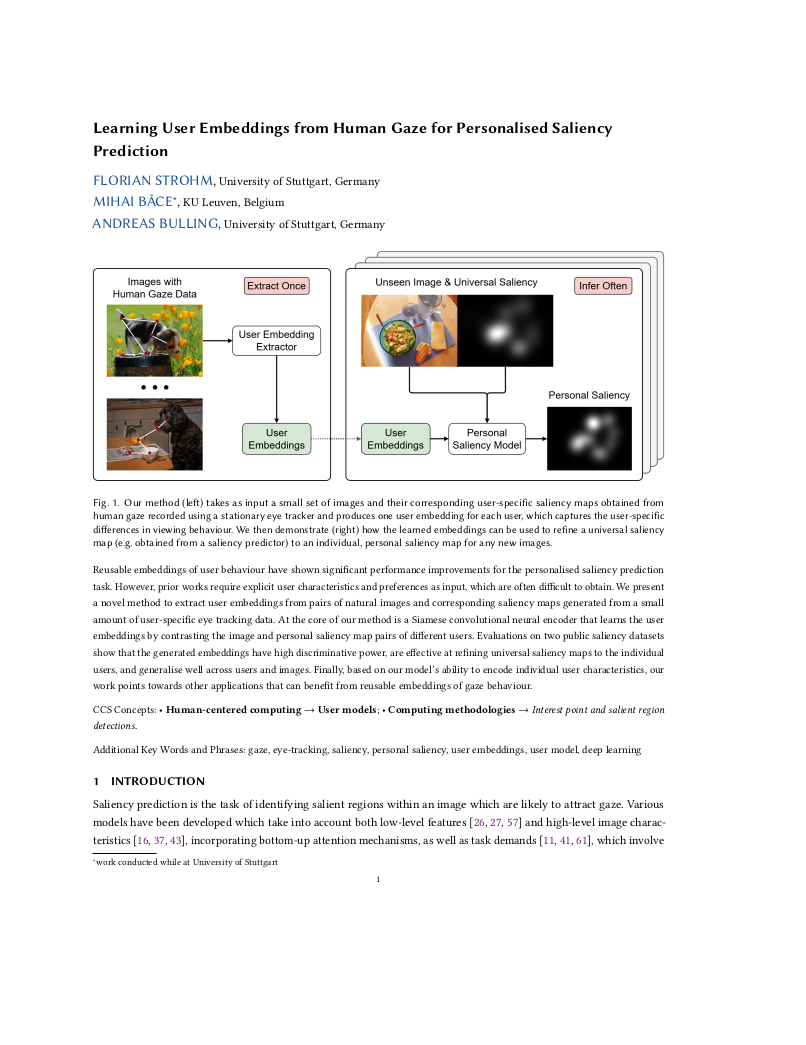
Reusable embeddings of user behaviour have shown significant performance improvements for the personalised saliency prediction task. However, prior works require explicit user characteristics and preferences as input, which are often difficult to obtain. We present a novel method to extract user embeddings from pairs of natural images and corresponding saliency maps generated from a small amount of user-specific eye tracking data. At the core of our method is a Siamese convolutional neural encoder that learns the user embeddings by contrasting the image and personal saliency map pairs of different users. Evaluations on two saliency datasets show that the generated embeddings have high discriminative power, are effective at refining universal saliency maps to the individual users, and generalise well across users and images. Finally, based on our model's ability to encode individual user characteristics, our work points towards other applications that can benefit from reusable embeddings of gaze behaviour.
@article{strohm24_etra,
title = {Learning User Embeddings from Human Gaze for Personalised Saliency Prediction},
author = {Florian Strohm and Mihai Bâce and Andreas Bulling},
year = {2024},
journal = {Proc. ACM on Human-Computer Interaction (PACM HCI)},
volume = {8},
number = {ETRA},
pages = {1--18},
doi = {10.1145/3655603},
}
VisRecall++: Analysing and Predicting Visualisation Recallability from Gaze Behaviour
Yao Wang, Yue Jiang, Zhiming Hu, Constantin Ruhdorfer, Mihai Bâce, Andreas Bulling
Proc. ACM on Human-Computer Interaction (PACM HCI), 8 (ETRA),pp. 1--18, 2024.
AbstractLinksBibTeXProject
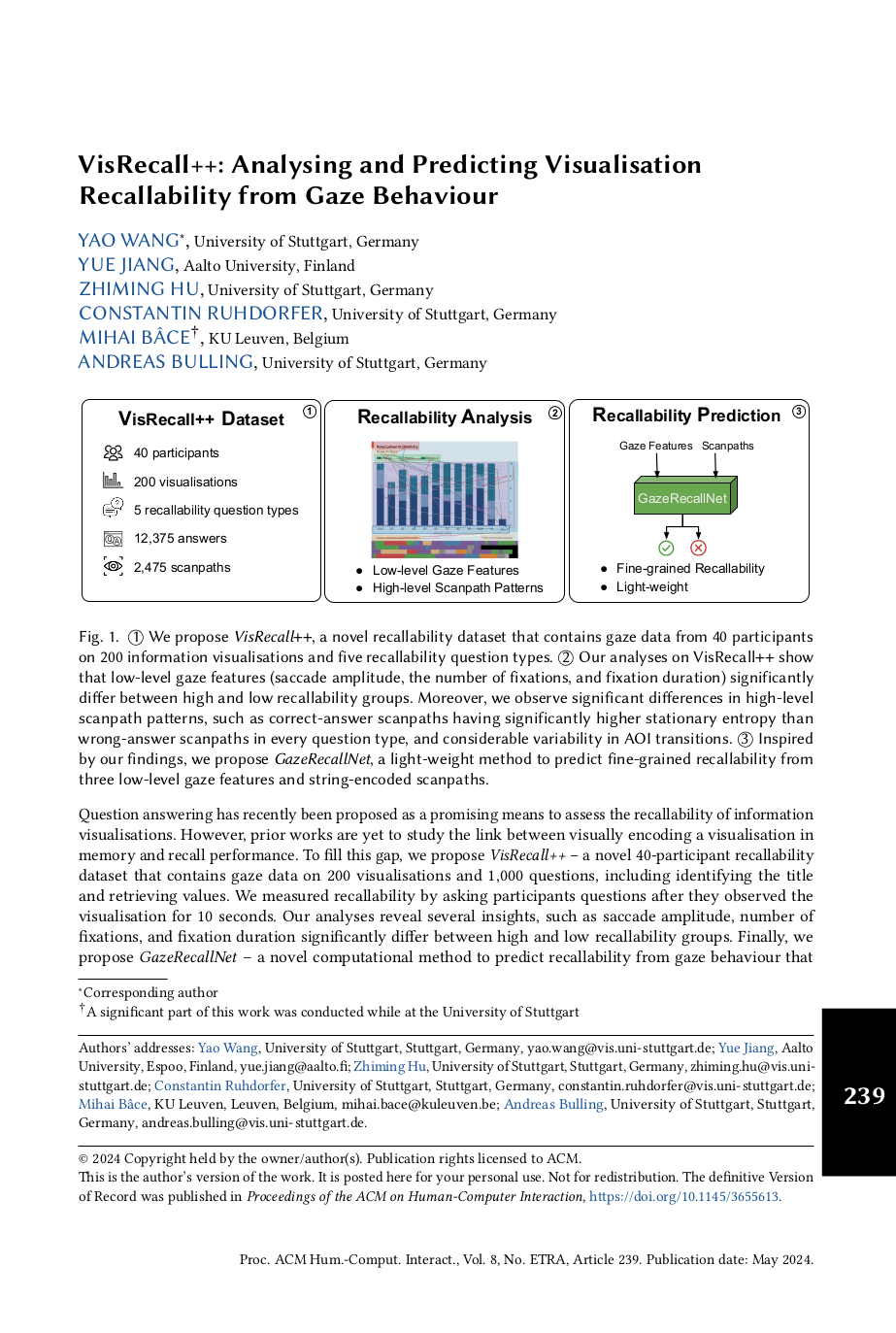
Question answering has recently been proposed as a promising means to assess the recallability of information visualisations. However, prior works are yet to study the link between visually encoding a visualisation in memory and recall performance. To fill this gap, we propose VisRecall++ – a novel 40-participant recallability dataset that contains gaze data on 200 visualisations and five question types, such as identifying the title, and finding extreme values.We measured recallability by asking participants questions after they observed the visualisation for 10 seconds.Our analyses reveal several insights, such as saccade amplitude, number of fixations, and fixation duration significantly differ between high and low recallability groups.Finally, we propose GazeRecallNet – a novel computational method to predict recallability from gaze behaviour that outperforms several baselines on this task.Taken together, our results shed light on assessing recallability from gaze behaviour and inform future work on recallability-based visualisation optimisation.
@article{wang24_etra,
title = {VisRecall++: Analysing and Predicting Visualisation Recallability from Gaze Behaviour},
author = {Yao Wang and Yue Jiang and Zhiming Hu and Constantin Ruhdorfer and Mihai Bâce and Andreas Bulling},
year = {2024},
journal = {Proc. ACM on Human-Computer Interaction (PACM HCI)},
volume = {8},
number = {ETRA},
pages = {1--18},
doi = {10.1145/3655613},
}
Saliency3D: a 3D Saliency Dataset Collected on Screen
Yao Wang, Qi Dai, Mihai Bâce, Karsten Klein, Andreas Bulling
Proc. ACM International Symposium on Eye Tracking Research and Applications (ETRA), pp. 1--9, 2024.
AbstractLinksBibTeXProject
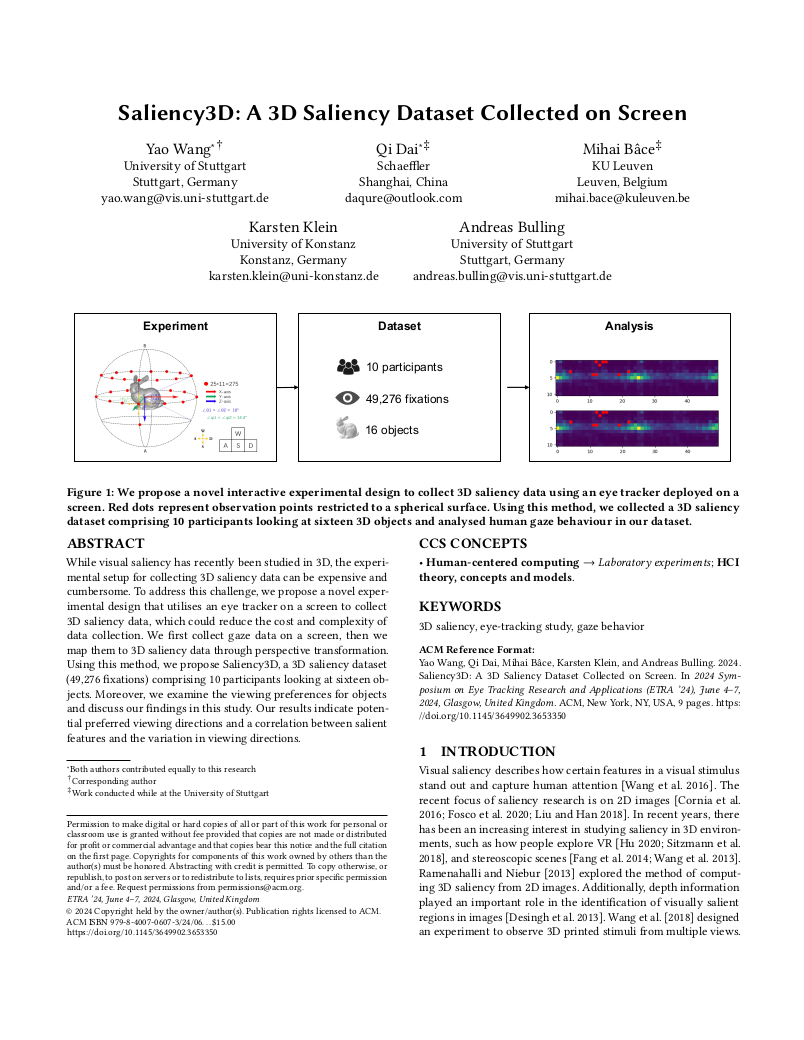
While visual saliency has recently been studied in 3D, the experimental setup for collecting 3D saliency data can be expensive and cumbersome. To address this challenge, we propose a novel experimental design that utilizes an eye tracker on a screen to collect 3D saliency data. Our experimental design reduces the cost and complexity of 3D saliency dataset collection. We first collect gaze data on a screen, then we map them to 3D saliency data through perspective transformation. Using this method, we collect a 3D saliency dataset (49,276 fixations) comprising 10 participants looking at sixteen objects. Moreover, we examine the viewing preferences for objects and discuss our findings in this study. Our results indicate potential preferred viewing directions and a correlation between salient features and the variation in viewing directions.
@inproceedings{wang24_etras,
title = {Saliency3D: a 3D Saliency Dataset Collected on Screen},
author = {Yao Wang and Qi Dai and Mihai B{\^a}ce and Karsten Klein and Andreas Bulling},
year = {2024},
booktitle = {Proc. ACM International Symposium on Eye Tracking Research and Applications (ETRA)},
pages = {1--9},
doi = {10.1145/3649902.3653350},
}