QualitEye: Public and Privacy-preserving Gaze Data Quality Verification
Mayar Elfares, Pascal Reisert, Ralf Küsters, Andreas Bulling
Proc. ACM on Human-Computer Interaction (PACM HCI), 2026.
AbstractLinksBibTeXProject
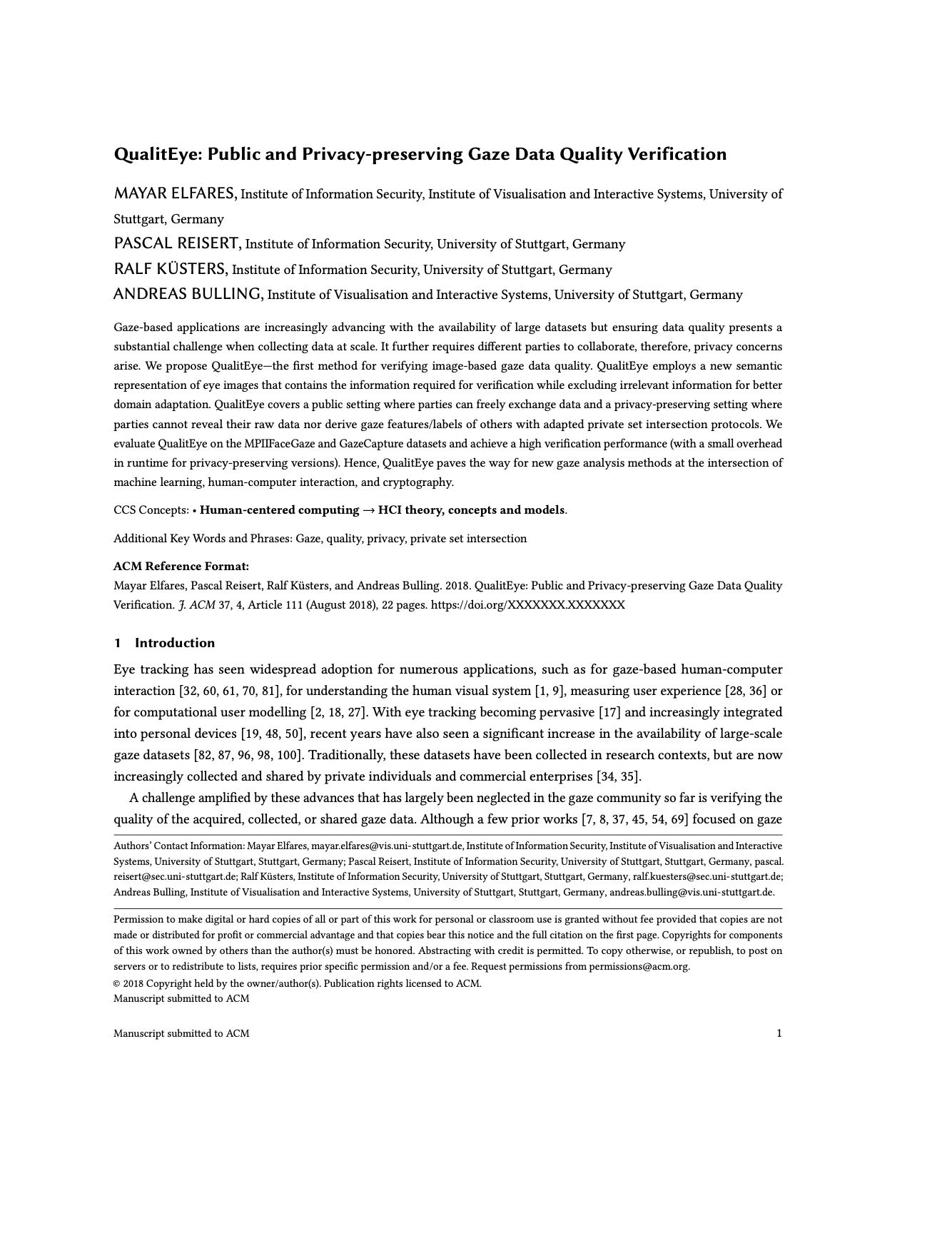
Gaze-based applications are increasingly advancing with the availability of large datasets but ensuring data quality presents a substantial challenge when collecting data at scale. It further requires different parties to collaborate, therefore, privacy concerns arise. We propose QualitEye - the first method for verifying image-based gaze data quality. QualitEye employs a new semantic representation of eye images that contains the information required for verification while excluding irrelevant information for better domain adaptation. QualitEye covers a public setting where parties can freely exchange data and a privacy-preserving setting where parties cannot reveal their raw data nor derive gaze features/labels of others with adapted private set intersection protocols. We evaluate QualitEye on the MPIIFaceGaze and GazeCapture datasets and achieve a high verification performance (with a small overhead in runtime for privacy-preserving versions). Hence, QualitEye paves the way for new gaze analysis methods at the intersection of machine learning, human-computer interaction, and cryptography.
@inproceedings{elfares26_etra,
title = {{QualitEye}: {Public} and {Privacy}-preserving {Gaze} {Data} {Quality} {Verification}},
author = {Elfares, Mayar and Reisert, Pascal and Küsters, Ralf and Bulling, Andreas},
year = {2026},
booktitle = {Proc. ACM on Human-Computer Interaction (PACM HCI)},
number = {ETRA},
shorttitle = {{QualitEye}},
}
Learning Alignments of Human Gaze and Fine-grained Task Descriptions
Takumi Nishiyasu, Zhiming Hu, Andreas Bulling, Yoichi Sato
Proc. ACM on Human-Computer Interaction (PACM HCI), 2026.
AbstractLinksBibTeXProject
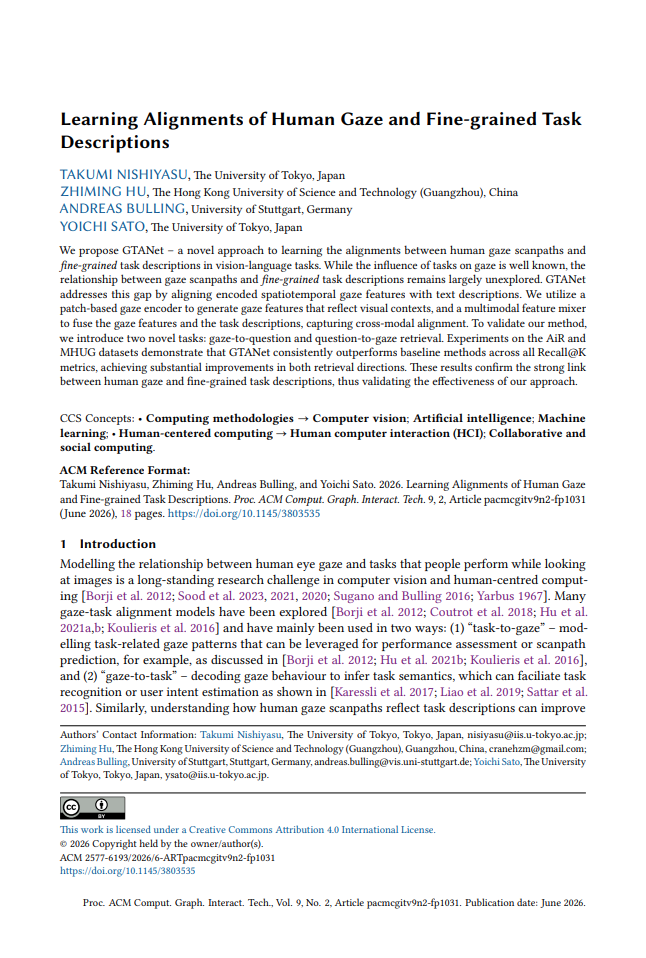
We propose GTANet - a novel approach to learning the alignments between human gaze scanpaths and fine-grained task descriptions in vision-language tasks. While the influence of tasks on gaze is known, the relationship between gaze scanpaths and fine-grained task descriptions remains largely unexplored. GTANet addresses this gap by aligning encoded spatiotemporal gaze features with text descriptions. We utilize a Patch-based Gaze Encoder to generate visual-context-aware gaze features, and a Multimodal Feature Mixer to fuse these, capturing cross-modal alignment. To validate the method, we introduce the novel tasks of gaze-based question retrieval and question-based gaze retrieval. Experiments on the AiR and MHUG datasets demonstrate that GTANet significantly and consistently outperforms baseline methods across all Recall@K metrics, achieving a substantial improvement in both gaze-to-task and task-to-gaze retrieval. These results confirm the strong link between human gaze and fine-grained task descriptions, validating the effectiveness of our approach.
@inproceedings{nishiyasu26_etra,
title = {Learning Alignments of Human Gaze and Fine-grained Task Descriptions},
author = {Nishiyasu, Takumi and Hu, Zhiming and Bulling, Andreas and Sato, Yoichi},
year = {2026},
booktitle = {Proc. ACM on Human-Computer Interaction (PACM HCI)},
number = {ETRA},
doi = {10.1145/3803535},
}