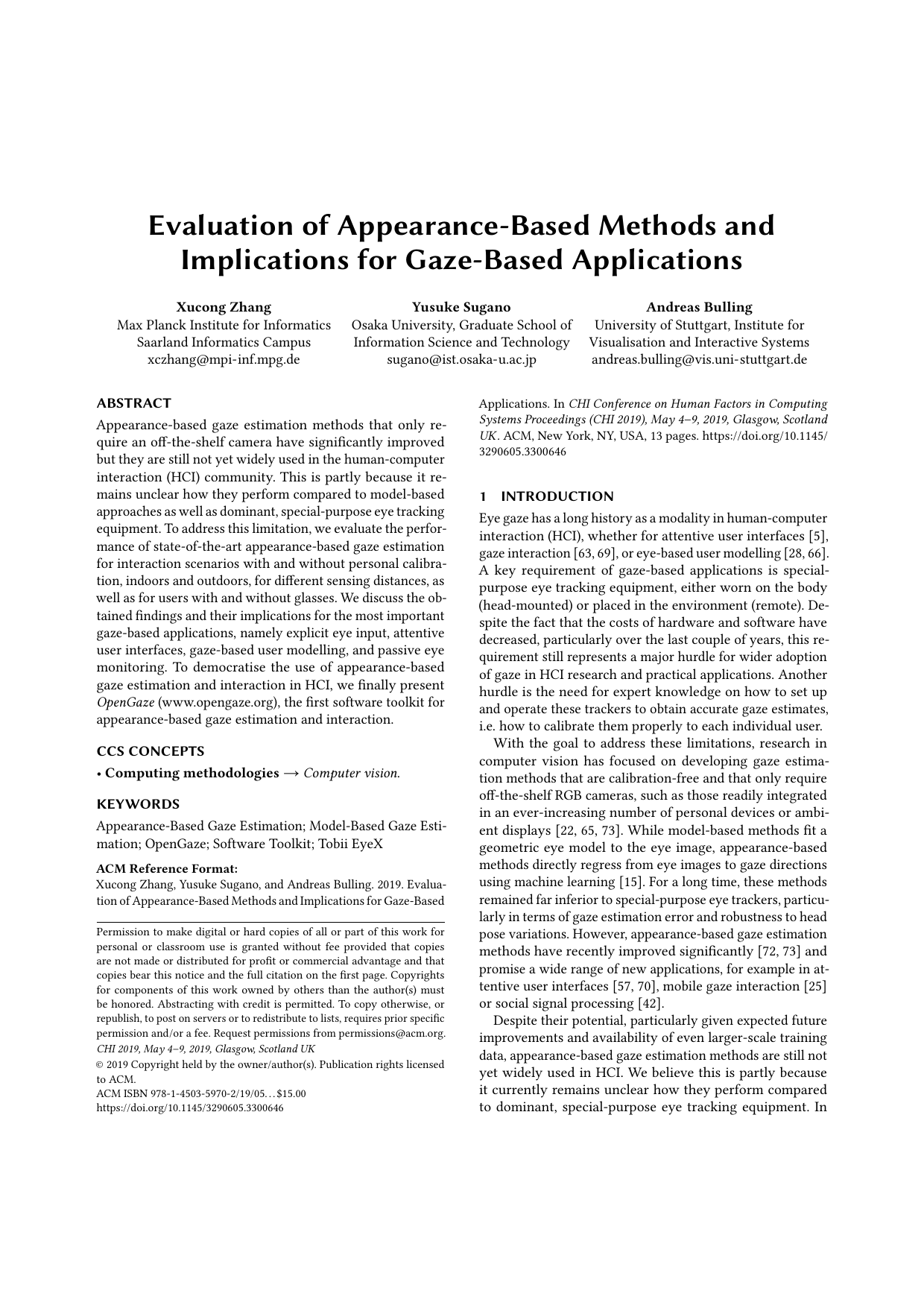
Evaluation of Appearance-Based Methods and Implications for Gaze-Based Applications
Xucong Zhang, Yusuke Sugano, Andreas Bulling
Proc. ACM SIGCHI Conference on Human Factors in Computing Systems (CHI), pp. 1--13, 2019.
AbstractLinksBibTeXProject
Appearance-based gaze estimation methods that only require an off-the-shelf camera have significantly improved but they are still not yet widely used in the human-computer interaction (HCI) community. This is partly because it remains unclear how they perform compared to model-based approaches as well as dominant, special-purpose eye tracking equipment. To address this limitation, we evaluate the performance of state-of-the-art appearance-based gaze estimation for interaction scenarios with and without personal calibration, indoors and outdoors, for different sensing distances, as well as for users with and without glasses. We discuss the obtained findings and their implications for the most important gaze-based applications, namely explicit eye input, attentive user interfaces, gaze-based user modelling, and passive eye monitoring. To democratise the use of appearance-based gaze estimation and interaction in HCI, we finally present OpenGaze (www.opengaze.org), the first software toolkit for appearance-based gaze estimation and interaction.
@inproceedings{zhang19_chi,
title = {Evaluation of Appearance-Based Methods and Implications for Gaze-Based Applications},
author = {Xucong Zhang and Yusuke Sugano and Andreas Bulling},
year = {2019},
booktitle = {Proc. ACM SIGCHI Conference on Human Factors in Computing Systems (CHI)},
pages = {1--13},
doi = {10.1145/3290605.3300646},
}
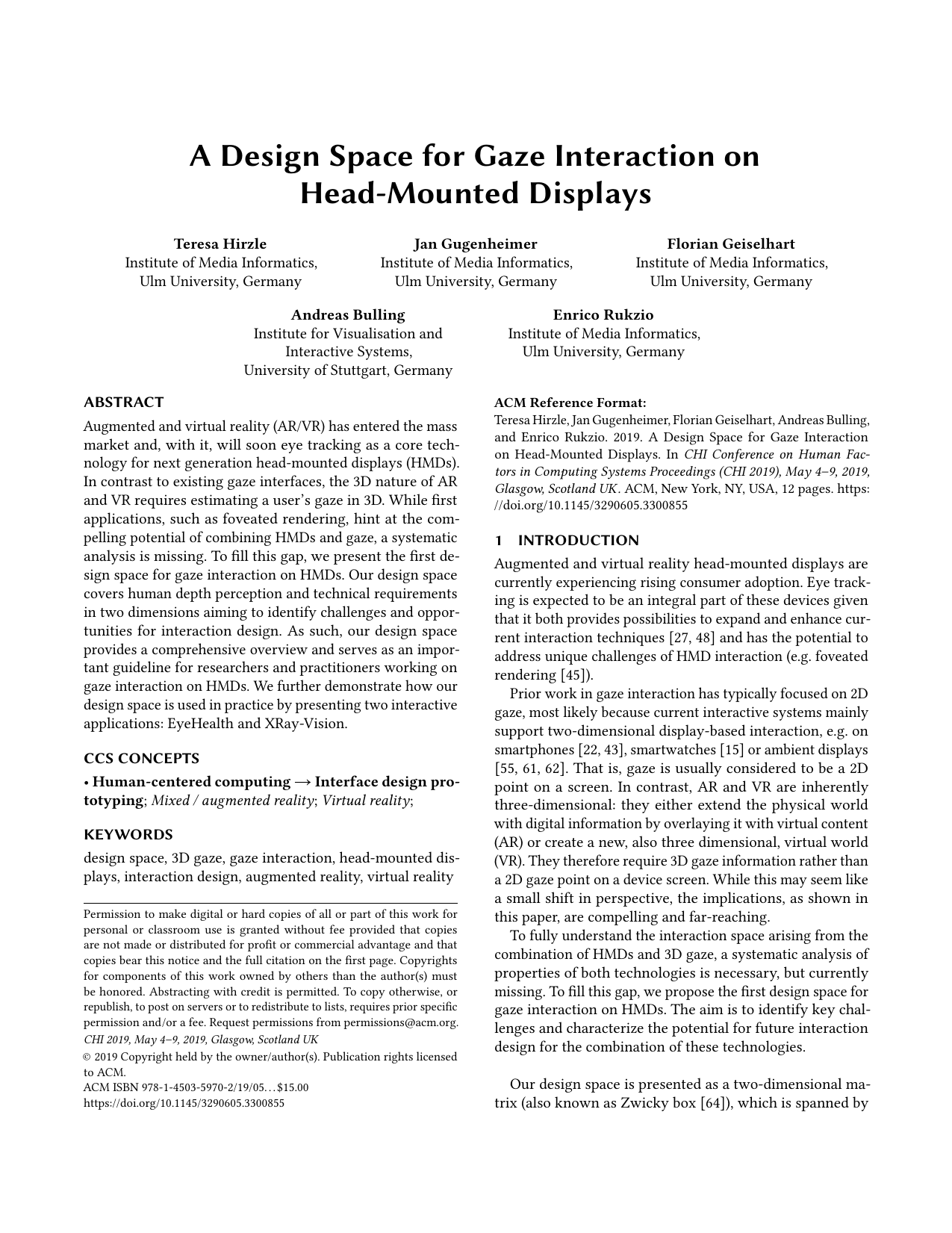
A Design Space for Gaze Interaction on Head-mounted Displays
Teresa Hirzle, Jan Gugenheimer, Florian Geiselhart, Andreas Bulling, Enrico Rukzio
Proc. ACM SIGCHI Conference on Human Factors in Computing Systems (CHI), pp. 1--12, 2019.
AbstractLinksBibTeXProject
Augmented and virtual reality (AR/VR) has entered the mass market and, with it, will soon eye tracking as a core technology for next generation head-mounted displays (HMDs). In contrast to existing gaze interfaces, the 3D nature of AR and VR requires estimating a user’s gaze in 3D. While first applications, such as foveated rendering, hint at the compelling potential of combining HMDs and gaze, a systematic analysis is missing. To fill this gap, we present the first design space for gaze interaction on HMDs. Our design space covers human depth perception and technical requirements in two dimensions aiming to identify challenges and opportunities for interaction design. As such, our design space provides a comprehensive overview and serves as an important guideline for researchers and practitioners working on gaze interaction on HMDs. We further demonstrate how our design space is used in practice by presenting two interactive applications: EyeHealth and XRay-Vision.
@inproceedings{hirzle19_chi,
title = {A Design Space for Gaze Interaction on Head-mounted Displays},
author = {Teresa Hirzle and Jan Gugenheimer and Florian Geiselhart and Andreas Bulling and Enrico Rukzio},
year = {2019},
booktitle = {Proc. ACM SIGCHI Conference on Human Factors in Computing Systems (CHI)},
pages = {1--12},
doi = {10.1145/3290605.3300855},
}
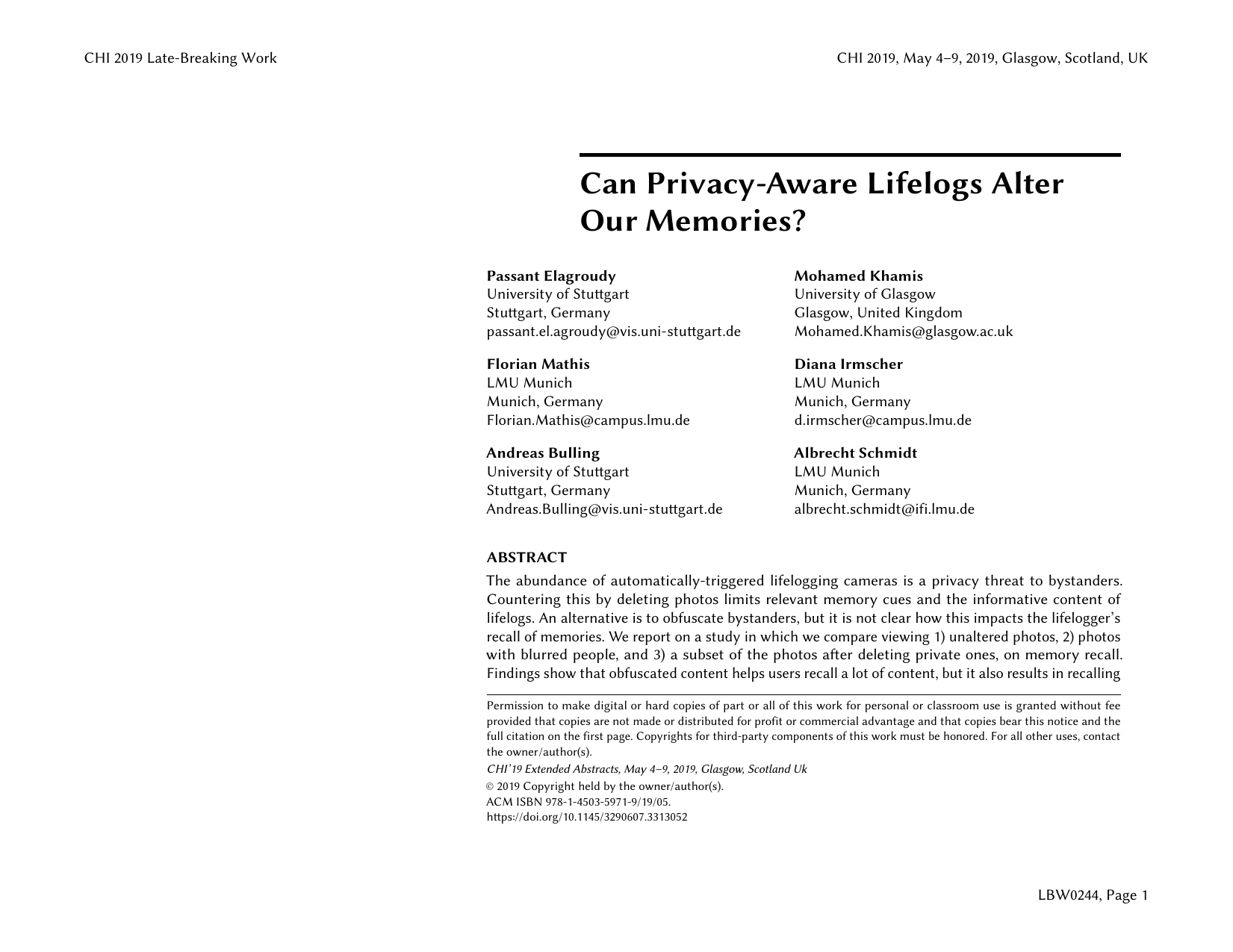
Can Privacy-Aware Lifelogs Alter Our Memories?
Passant Elagroudy, Florian Mathis, Andreas Bulling, Mohamed Khamis, Diana Irmscher, Albrecht Schmidt
Ext. Abstr. ACM SIGCHI Conference on Human Factors in Computing Systems (CHI), pp. 1--6, 2019.
AbstractLinksBibTeXProject
The abundance of automatically-triggered lifelogging cameras is a privacy threat to bystanders. Countering this by deleting photos limits relevant memory cues and the informative content of lifelogs. An alternative is to obfuscate bystanders, but it is not clear how this impacts the lifelogger’s recall of memories. We report on a study in which we compare viewing 1) unaltered photos, 2) photos with blurred people, and 3) a subset of the photos after deleting private ones, on memory recall. Findings show that obfuscated content helps users recall a lot of content, but it also results in recalling less accurate details, which can sometimes mislead the user. Our work informs the design of privacy- aware lifelogging systems that maximizes recall and steers discussion about ubiquitous technologies that could alter human memories.
@inproceedings{elagroudy19_chi,
title = {Can Privacy-Aware Lifelogs Alter Our Memories?},
author = {Passant Elagroudy and Florian Mathis and Andreas Bulling and Mohamed Khamis and Diana Irmscher and Albrecht Schmidt},
year = {2019},
booktitle = {Ext. Abstr. ACM SIGCHI Conference on Human Factors in Computing Systems (CHI)},
pages = {1--6},
doi = {10.1145/3290607.3313052},
}