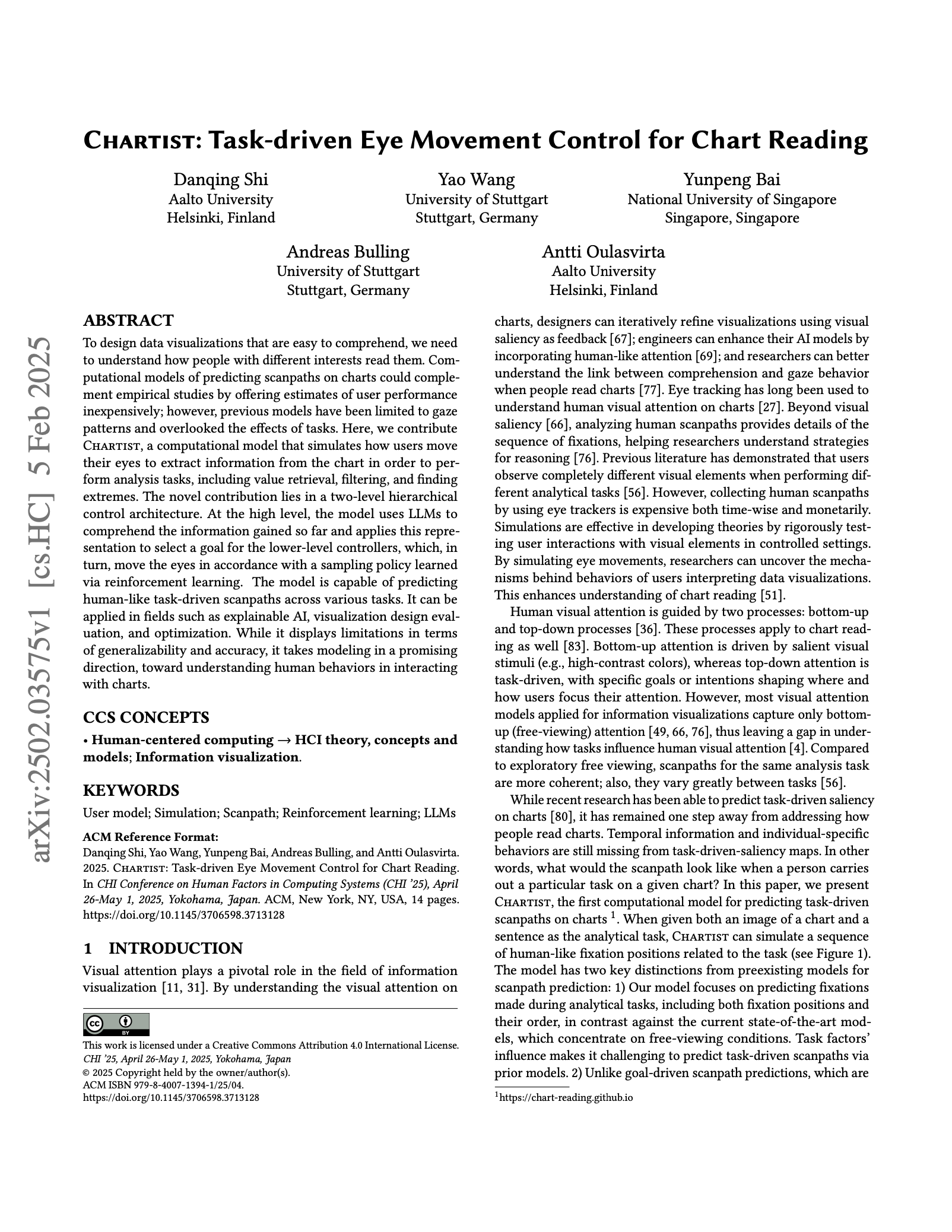
Chartist: Task-driven Eye Movement Control for Chart Reading
Danqing Shi, Yao Wang, Yunpeng Bai, Andreas Bulling, Antti Oulasvirta
Proc. ACM SIGCHI Conference on Human Factors in Computing Systems (CHI), pp. 1--14, 2025.
AbstractLinksBibTeXProject
To design data visualizations that are easy to comprehend, we need to understand how people with different interests read them. Computational models of modeling scanpaths on charts could complement empirical studies by offering estimates of user performance inexpensively; however, previous models have been limited to gaze patterns and overlooked the effects of tasks. Here, we contribute a model that simulates how users move their eyes to extract information from the chart in order to solve analytical tasks, including retrieve value, filter, and find extreme. Our insight is a two-level hierarchical control structure. At the high level, the model uses a LLM to comprehend information gained so far and uses this representation to select a goal for the lower-level controllers, which in turn move the eyes according to a sampling policy learned via reinforcement learning. The model can accurately predict task-driven scanpaths and reproduce the human-like statistical summary across tasks.
@inproceedings{shi25_chi,
title = {Chartist: Task-driven Eye Movement Control for Chart Reading},
author = {Shi, Danqing and Wang, Yao and Bai, Yunpeng and Bulling, Andreas and Oulasvirta, Antti},
year = {2025},
booktitle = {Proc. ACM SIGCHI Conference on Human Factors in Computing Systems (CHI)},
pages = {1--14},
doi = {10.1145/3706598.3713128},
}
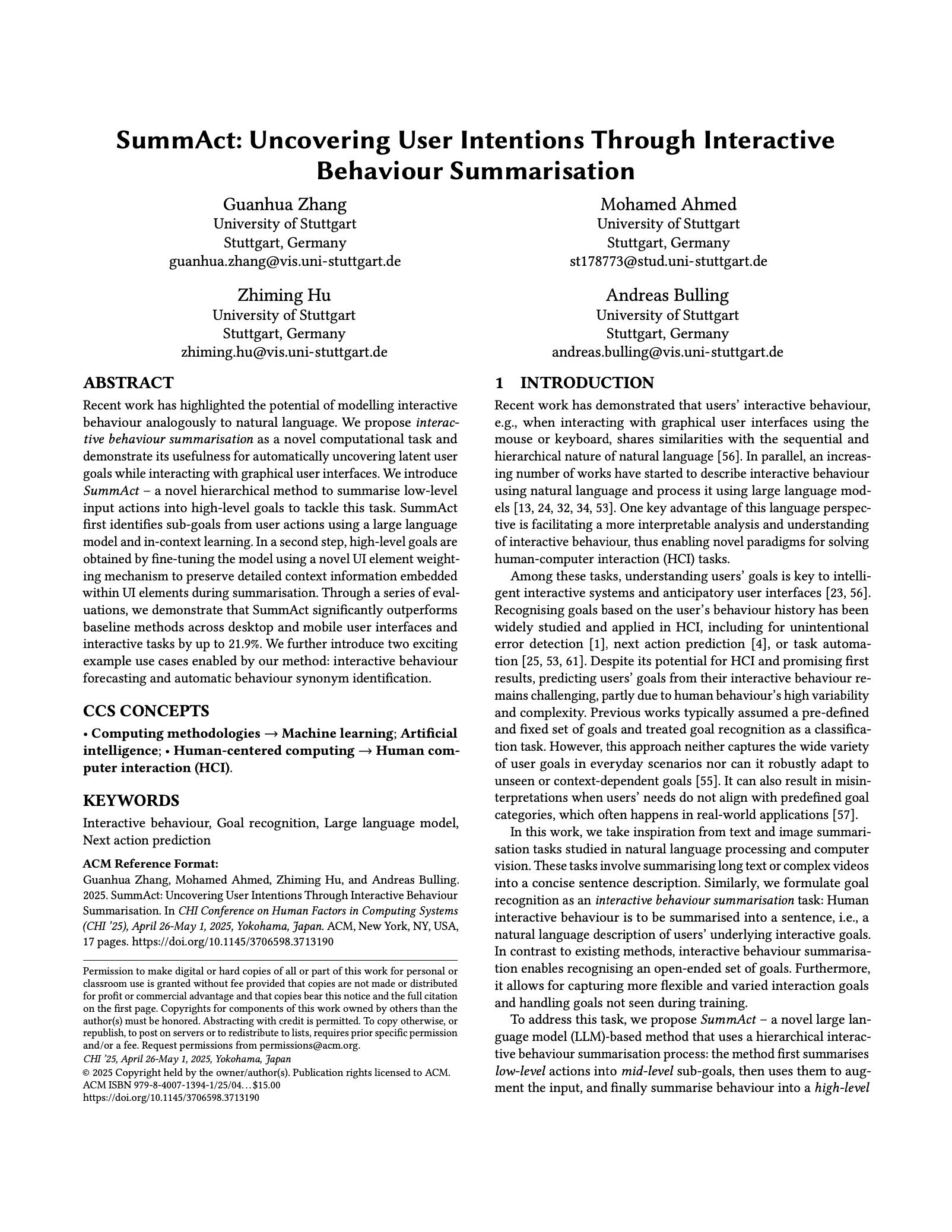
SummAct: Uncovering User Intentions Through Interactive Behaviour Summarisation
Guanhua Zhang, Mohamed Ahmed, Zhiming Hu, Andreas Bulling
Proc. ACM SIGCHI Conference on Human Factors in Computing Systems (CHI), pp. 1--23, 2025.
AbstractLinksBibTeXProject
Recent work has highlighted the potential of modelling interactive behaviour analogously to natural language. We propose interactive behaviour summarisation as a novel computational task and demonstrate its usefulness for automatically uncovering latent user intentions while interacting with graphical user interfaces. To tackle this task, we introduce SummAct – a novel hierarchical method to summarise low-level input actions into high-level intentions. SummAct first identifies sub-goals from user actions using a large language model and in-context learning. High-level intentions are then obtained by fine-tuning the model using a novel UI element attention to preserve detailed context information embedded within UI elements during summarisation. Through a series of evaluations, we demonstrate that SummAct significantly outperforms baselines across desktop and mobile interfaces as well as interactive tasks by up to 21.9%. We further show three exciting interactive applications benefited from SummAct: interactive behaviour forecasting, automatic behaviour synonym identification, and language-based behaviour retrieval.
@inproceedings{zhang25_chi,
title = {SummAct: Uncovering User Intentions Through Interactive Behaviour Summarisation},
author = {Guanhua Zhang and Mohamed Ahmed and Zhiming Hu and Andreas Bulling},
year = {2025},
booktitle = {Proc. ACM SIGCHI Conference on Human Factors in Computing Systems (CHI)},
pages = {1--23},
doi = {10.1145/3706598.3713190},
}