SalChartQA: Question-driven Saliency on Information Visualisations
Yao Wang, Weitian Wang, Abdullah Abdelhafez, Mayar Elfares, Zhiming Hu, Mihai Bâce, Andreas Bulling
Proc. ACM SIGCHI Conference on Human Factors in Computing Systems (CHI), pp. 1--14, 2024.
AbstractLinksBibTeXProject
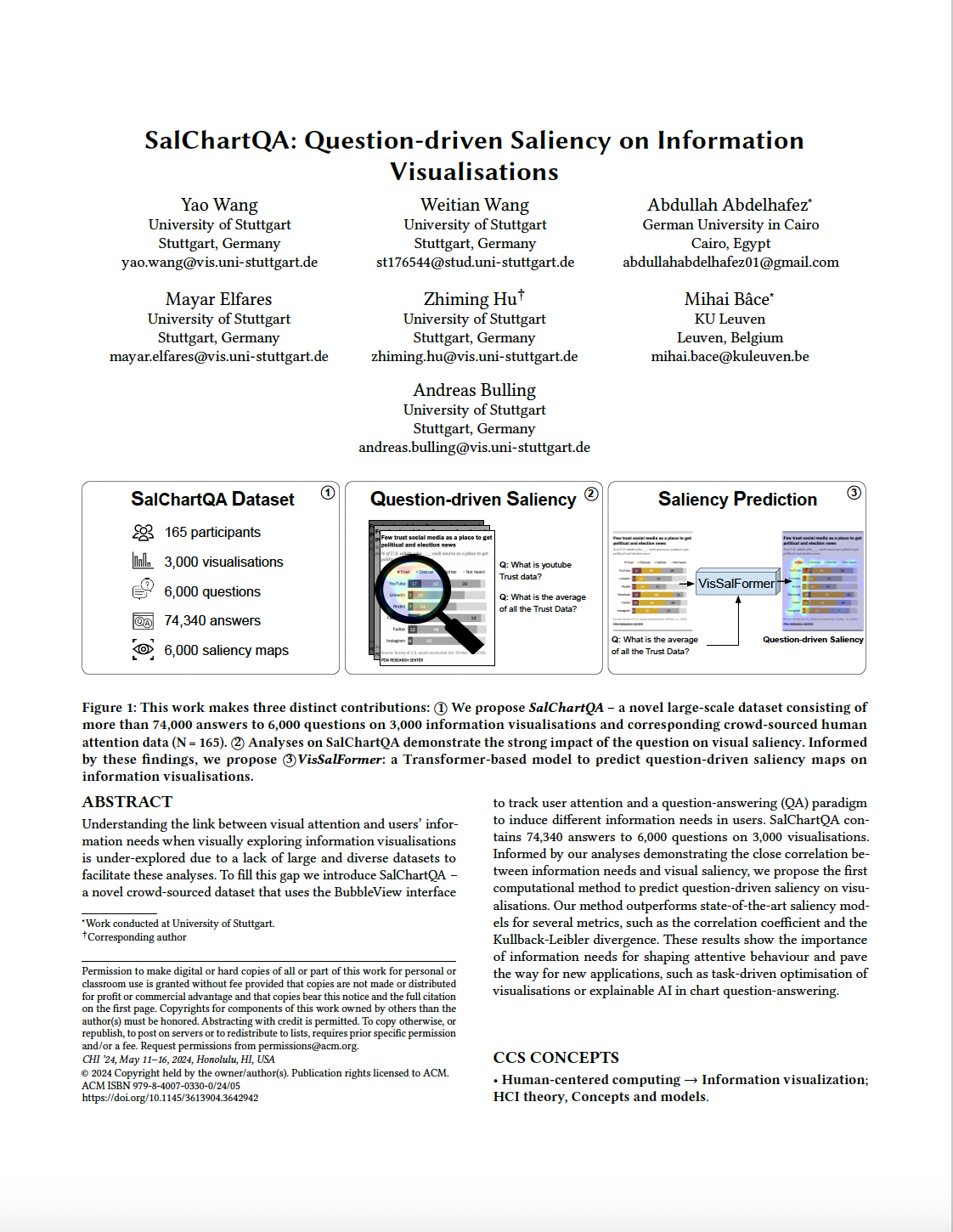
Understanding the link between visual attention and user's needs when visually exploring information visualisations is under-explored due to a lack of large and diverse datasets to facilitate these analyses. To fill this gap, we introduce SalChartQA – a novel crowd-sourced dataset that uses the BubbleView interface as a proxy for human gaze and a question-answering (QA) paradigm to induce different information needs in users. SalChartQA contains 74,340 answers to 6,000 questions on 3,000 visualisations. Informed by our analyses demonstrating the tight correlation between the question and visual saliency, we propose the first computational method to predict question-driven saliency on information visualisations. Our method outperforms state-of-the-art saliency models, improving several metrics, such as the correlation coefficient and the Kullback-Leibler divergence. These results show the importance of information needs for shaping attention behaviour and paving the way for new applications, such as task-driven optimisation of visualisations or explainable AI in chart question-answering.
@inproceedings{wang24_chi,
title = {SalChartQA: Question-driven Saliency on Information Visualisations},
author = {Yao Wang and Weitian Wang and Abdullah Abdelhafez and Mayar Elfares and Zhiming Hu and Mihai B{\^a}ce and Andreas Bulling},
year = {2024},
booktitle = {Proc. ACM SIGCHI Conference on Human Factors in Computing Systems (CHI)},
pages = {1--14},
doi = {10.1145/3613904.3642942},
}
Mouse2Vec: Learning Reusable Semantic Representations of Mouse Behaviour
Guanhua Zhang, Zhiming Hu, Mihai Bâce, Andreas Bulling
Proc. ACM SIGCHI Conference on Human Factors in Computing Systems (CHI), pp. 1--17, 2024.
AbstractLinksBibTeXProject
The mouse is a pervasive input device used for a wide range of interactive applications. However, computational modelling of mouse behaviour typically requires time-consuming design and extraction of handcrafted features, or approaches that are application-specific. We instead propose Mouse2Vec – a novel self-supervised method designed to learn semantic representations of mouse behaviour that are reusable across users and applications. Mouse2Vec uses a Transformer-based encoder-decoder architecture, which is specifically geared for mouse data: During pretraining, the encoder learns an embedding of input mouse trajectories while the decoder reconstructs the input and simultaneously detects mouse click events. We show that the representations learned by our method can identify interpretable mouse behaviour clusters and retrieve similar mouse trajectories. We also demonstrate on three sample downstream tasks that the representations can be practically used to augment mouse data for training supervised methods and serve as an effective feature extractor.
@inproceedings{zhang24_chi,
title = {Mouse2Vec: Learning Reusable Semantic Representations of Mouse Behaviour},
author = {Guanhua Zhang and Zhiming Hu and Mihai B{\^a}ce and Andreas Bulling},
year = {2024},
booktitle = {Proc. ACM SIGCHI Conference on Human Factors in Computing Systems (CHI)},
pages = {1--17},
doi = {10.1145/3613904.3642141},
}