Prediction of Gaze Estimation Error for Error-Aware Gaze-Based Interfaces
Michael Barz, Florian Daiber, Andreas Bulling
Proc. International ACM Symposium on Eye Tracking Research and Applications (ETRA), pp. 275-278, 2016.
AbstractLinksBibTeXProject
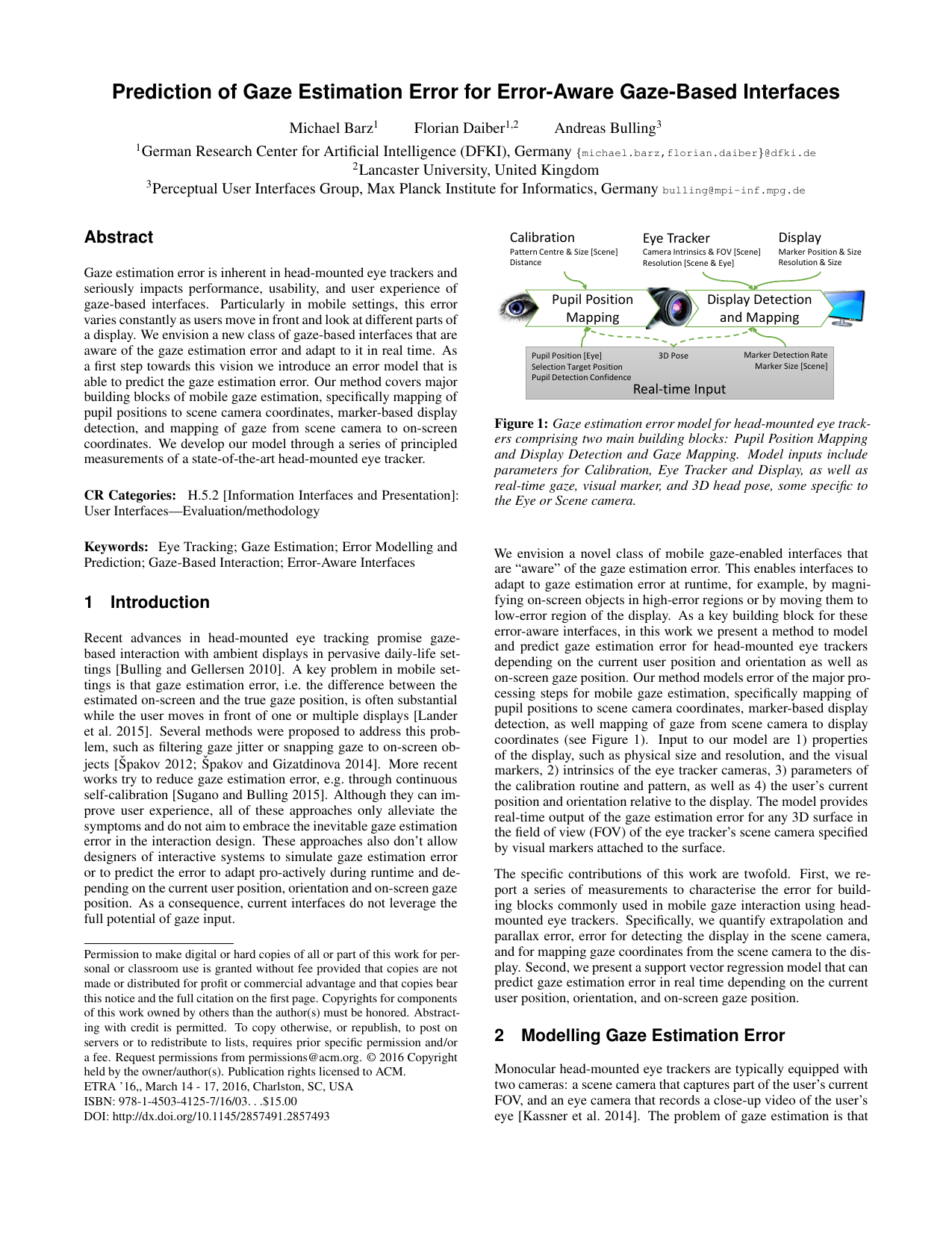
Gaze estimation error is inherent in head-mounted eye trackers and seriously impacts performance, usability, and user experience of gaze-based interfaces. Particularly in mobile settings, this error varies constantly as users move in front and look at different parts of a display. We envision a new class of gaze-based interfaces that are aware of the gaze estimation error and adapt to it in real time. As a first step towards this vision we introduce an error model that is able to predict the gaze estimation error. Our method covers major building blocks of mobile gaze estimation, specifically mapping of pupil positions to scene camera coordinates, marker-based display detection, and mapping of gaze from scene camera to on-screen coordinates. We develop our model through a series of principled measurements of a state-of-the-art head-mounted eye tracker.
@inproceedings{barz16_etra,
title = {Prediction of Gaze Estimation Error for Error-Aware Gaze-Based Interfaces},
author = {Barz, Michael and Daiber, Florian and Bulling, Andreas},
year = {2016},
booktitle = {Proc. International ACM Symposium on Eye Tracking Research and Applications (ETRA)},
pages = {275-278},
doi = {10.1145/2857491.2857493},
}
3D Gaze Estimation from 2D Pupil Positions on Monocular Head-Mounted Eye Trackers
Mohsen Mansouryar, Julian Steil, Yusuke Sugano, Andreas Bulling
Proc. ACM International Symposium on Eye Tracking Research and Applications (ETRA), pp. 197-200, 2016.
AbstractLinksBibTeXProject
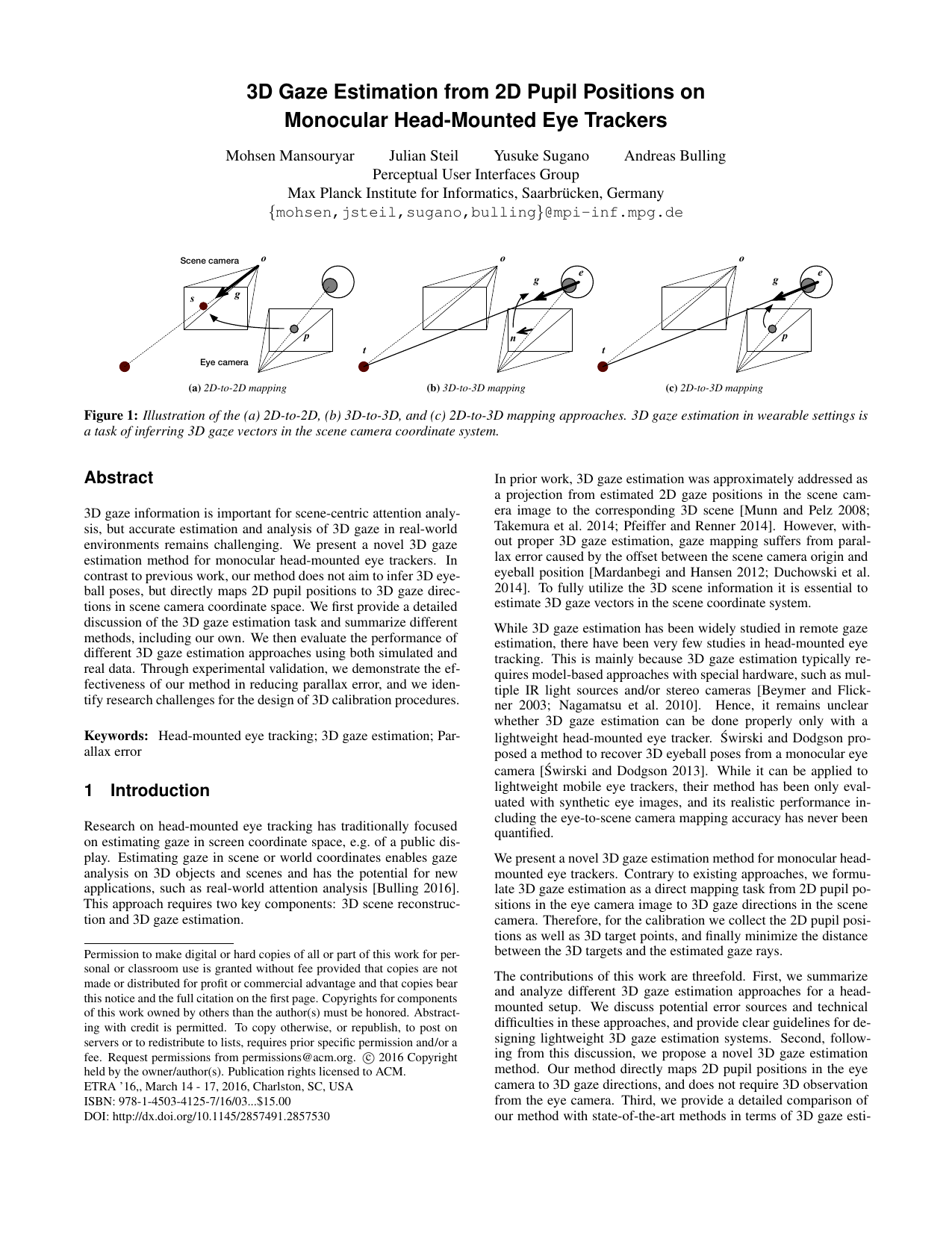
3D gaze information is important for scene-centric attention analysis, but accurate estimation and analysis of 3D gaze in real-world environments remains challenging. We present a novel 3D gaze estimation method for monocular head-mounted eye trackers. In contrast to previous work, our method does not aim to infer 3D eye- ball poses, but directly maps 2D pupil positions to 3D gaze directions in scene camera coordinate space. We first provide a detailed discussion of the 3D gaze estimation task and summarize different methods, including our own. We then evaluate the performance of different 3D gaze estimation approaches using both simulated and real data. Through experimental validation, we demonstrate the effectiveness of our method in reducing parallax error, and we identify research challenges for the design of 3D calibration procedures.
@inproceedings{mansouryar16_etra,
title = {3D Gaze Estimation from 2D Pupil Positions on Monocular Head-Mounted Eye Trackers},
author = {Mohsen Mansouryar and Julian Steil and Yusuke Sugano and Andreas Bulling},
year = {2016},
booktitle = {Proc. ACM International Symposium on Eye Tracking Research and Applications (ETRA)},
pages = {197-200},
doi = {10.1145/2857491.2857530},
}
Gaussian Processes as an Alternative to Polynomial Gaze Estimation Functions
Laura Sesma-Sanchez, Yanxia Zhang, Andreas Bulling, Hans Gellersen
Proc. ACM International Symposium on Eye Tracking Research and Applications (ETRA), pp. 229-232, 2016.
AbstractLinksBibTeXProject
Interpolation-based methods are widely used for gaze estimation due to their simplicity. In particular, feature-based methods that map the image eye features to gaze, are very popular. The most spread regression function used in this kind of method is the polynomial regression. In this paper, we present an alternative regression function to estimate gaze: the Gaussian regression. We show how the Gaussian processes can better adapt to the non-linear behavior of the eye movement, providing higher gaze estimation accuracies. The Gaussian regression is compared, in a simulated environment, to the polynomial regression, when using the same mapping features, the normalized pupil center-corneal reflection and pupil center-eye corners vectors. This comparison is done for three different screen sizes. The results show that for larger screens, where wider gaze angles are required, i.e., the non-linear behavior of the eye is more present, the outperformance of the Gaussian regression is more evident. Furthermore, we can conclude that, for both types of regressions, the gaze estimation accuracy increases for smaller screens, where the eye movements are more linear.
@inproceedings{sesma16_etra,
title = {Gaussian Processes as an Alternative to Polynomial Gaze Estimation Functions},
author = {Laura Sesma-Sanchez and Yanxia Zhang and Andreas Bulling and Hans Gellersen},
year = {2016},
booktitle = {Proc. ACM International Symposium on Eye Tracking Research and Applications (ETRA)},
pages = {229-232},
doi = {10.1145/2857491.2857509},
}
Labeled pupils in the wild: A dataset for studying pupil detection in unconstrained environments
Marc Tonsen, Xucong Zhang, Yusuke Sugano, Andreas Bulling
Proc. ACM International Symposium on Eye Tracking Research and Applications (ETRA), pp. 139-142, 2016.
AbstractLinksBibTeXProject
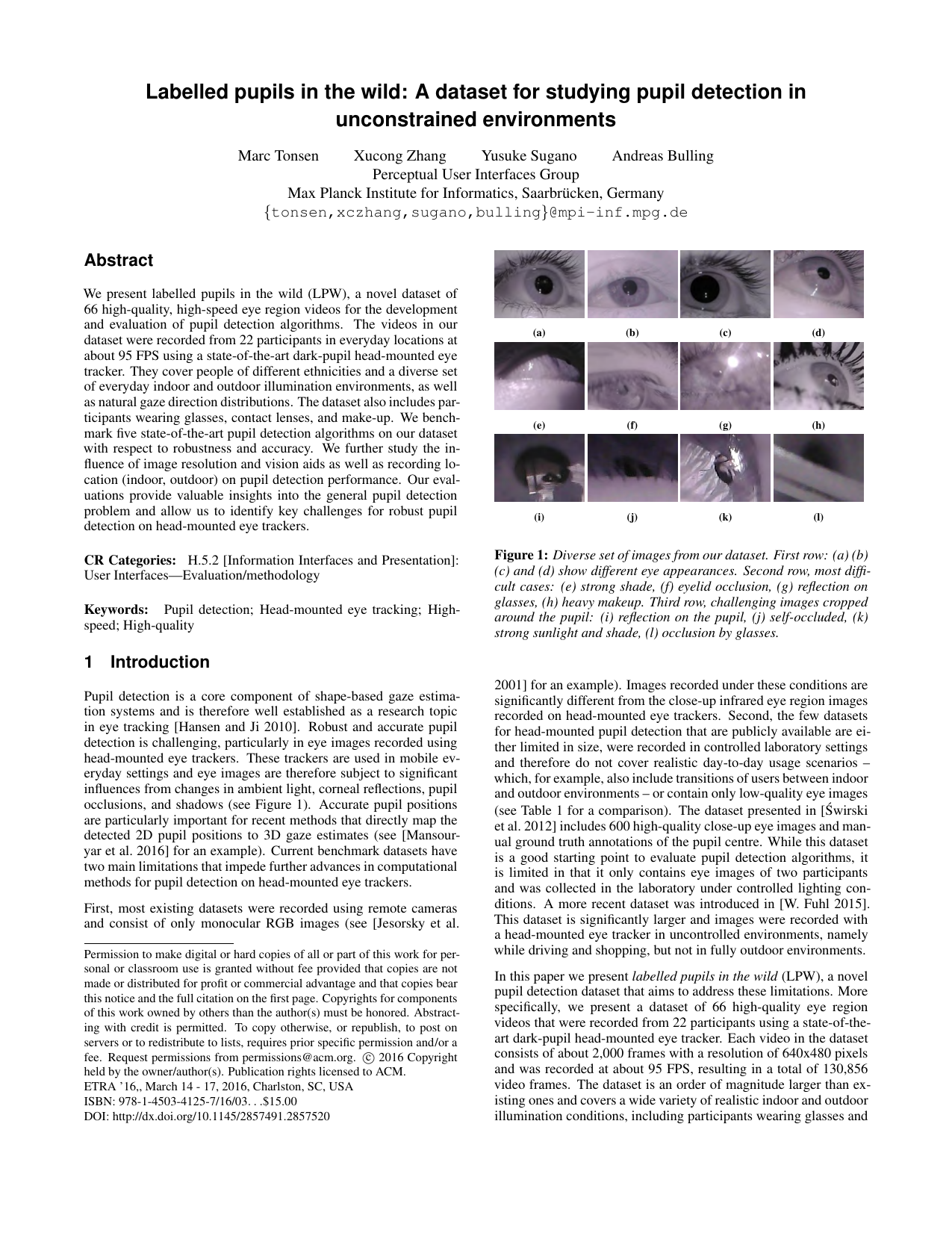
We present labelled pupils in the wild (LPW), a novel dataset of 66 high-quality, high-speed eye region videos for the development and evaluation of pupil detection algorithms. The videos in our dataset were recorded from 22 participants in everyday locations at about 95 FPS using a state-of-the-art dark-pupil head-mounted eye tracker. They cover people of different ethnicities and a diverse set of everyday indoor and outdoor illumination environments, as well as natural gaze direction distributions. The dataset also includes participants wearing glasses, contact lenses, and make-up. We bench- mark five state-of-the-art pupil detection algorithms on our dataset with respect to robustness and accuracy. We further study the influence of image resolution and vision aids as well as recording lo- cation (indoor, outdoor) on pupil detection performance. Our evaluations provide valuable insights into the general pupil detection problem and allow us to identify key challenges for robust pupil detection on head-mounted eye trackers.
@inproceedings{tonsen16_etra,
title = {Labeled pupils in the wild: A dataset for studying pupil detection in unconstrained environments},
author = {Marc Tonsen and Xucong Zhang and Yusuke Sugano and Andreas Bulling},
year = {2016},
booktitle = {Proc. ACM International Symposium on Eye Tracking Research and Applications (ETRA)},
pages = {139-142},
doi = {10.1145/2857491.2857520},
}
Learning an appearance-based gaze estimator from one million synthesised images
Erroll Wood, Tadas Baltru{\v{s}}aitis, Louis-Philippe Morency, Peter Robinson, Andreas Bulling
Proc. ACM International Symposium on Eye Tracking Research and Applications (ETRA), pp. 131--138, 2016.
AbstractLinksBibTeXProject Emerging Investigator Award
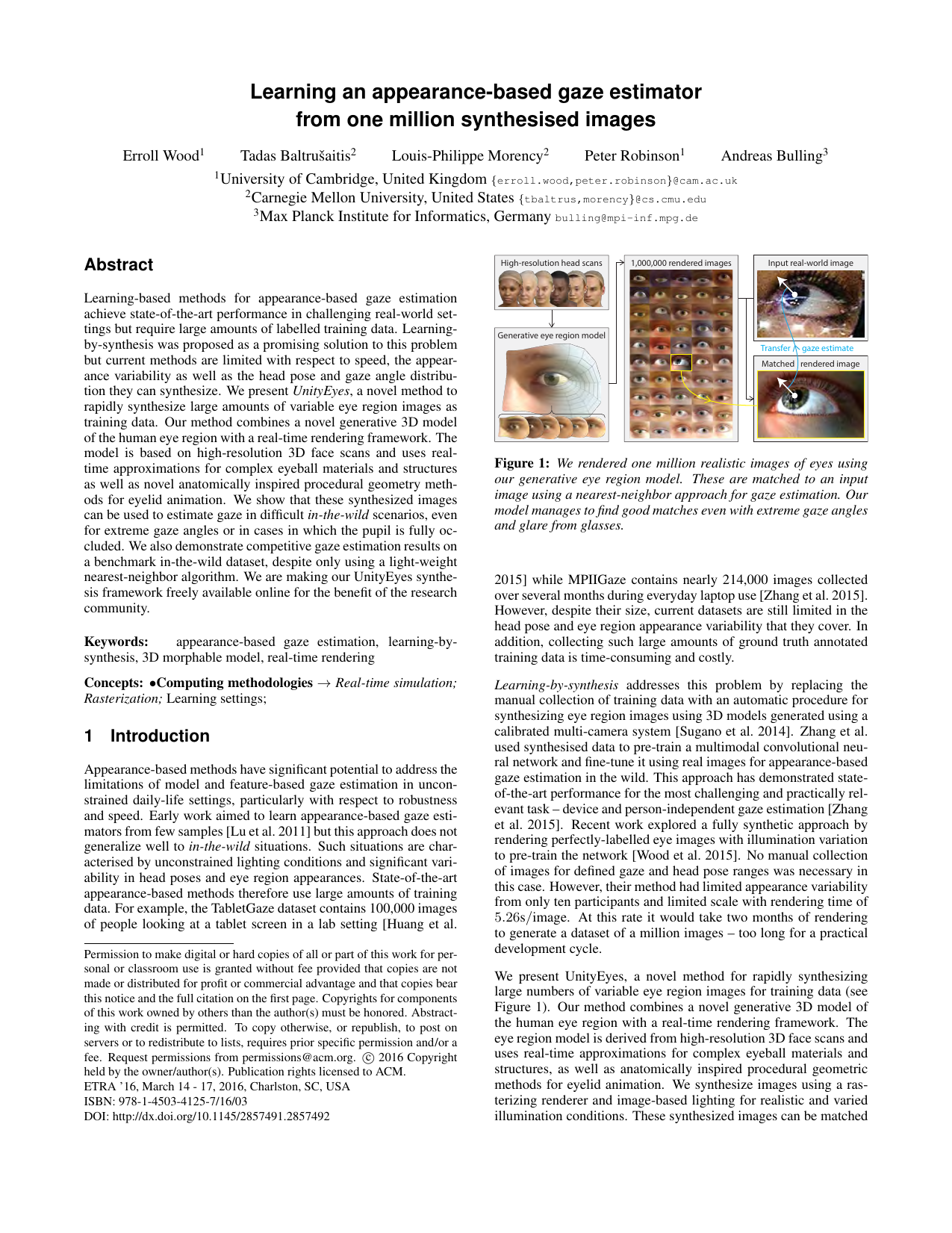
Learning-based methods for appearance-based gaze estimation achieve state-of-the-art performance in challenging real-world settings but require large amounts of labelled training data. Learning-by-synthesis was proposed as a promising solution to this problem but current methods are limited with respect to speed, the appearance variability as well as the head pose and gaze angle distribution they can synthesize. We present UnityEyes, a novel method to rapidly synthesize large amounts of variable eye region images as training data. Our method combines a novel generative 3D model of the human eye region with a real-time rendering framework. The model is based on high-resolution 3D face scans and uses real- time approximations for complex eyeball materials and structures as well as novel anatomically inspired procedural geometry methods for eyelid animation. We show that these synthesized images can be used to estimate gaze in difficult in-the-wild scenarios, even for extreme gaze angles or in cases in which the pupil is fully occluded. We also demonstrate competitive gaze estimation results on a benchmark in-the-wild dataset, despite only using a light-weight nearest-neighbor algorithm. We are making our UnityEyes synthesis framework freely available online for the benefit of the research community.
@inproceedings{wood16_etra,
title = {Learning an appearance-based gaze estimator from one million synthesised images},
author = {Erroll Wood and Tadas Baltru{\v{s}}aitis and Louis-Philippe Morency and Peter Robinson and Andreas Bulling},
year = {2016},
booktitle = {Proc. ACM International Symposium on Eye Tracking Research and Applications (ETRA)},
pages = {131--138},
doi = {10.1145/2857491.2857492},
}