A Survey of Digital Eye Strain in Gaze-Based Interactive Systems
Teresa Hirzle, Maurice Cordts, Enrico Rukzio, Andreas Bulling
Proc. ACM International Symposium on Eye Tracking Research and Applications (ETRA), pp. 1-12, 2020.
AbstractLinksBibTeXProject
Display-based interfaces pose high demands on users’ eyes that can cause severe vision and eye problems, also known as digital eye strain (DES). Although these problems can become even more severe if the eyes are actively used for interaction, prior work on gaze-based interfaces has largely neglected these risks. We offer the first comprehensive account of DES in gaze-based interactive systems that is specifically geared to gaze interaction designers. Through an extensive survey of more than 400 papers published over the last 46 years, we first discuss the current role of DES in interactive systems. One key finding is that DES is only rarely considered when evaluating novel gaze interfaces and neglected in discussions of usability. We identify the main causes and solutions to DES and derive recommendations for interaction designers on how to guide future research on evaluating and alleviating DES.
@inproceedings{hirzle20_etra,
title = {A Survey of Digital Eye Strain in Gaze-Based Interactive Systems},
author = {Teresa Hirzle and Maurice Cordts and Enrico Rukzio and Andreas Bulling},
year = {2020},
booktitle = {Proc. ACM International Symposium on Eye Tracking Research and Applications (ETRA)},
pages = {1-12},
doi = {10.1145/3379155.3391313},
}
Combining Gaze Estimation and Optical Flow for Pursuits Interaction
Mihai Bâce, Vincent Becker, Chenyang Wang, Andreas Bulling
Proc. ACM International Symposium on Eye Tracking Research and Applications (ETRA), pp. 1-10, 2020.
AbstractLinksBibTeXProject Best Paper Award
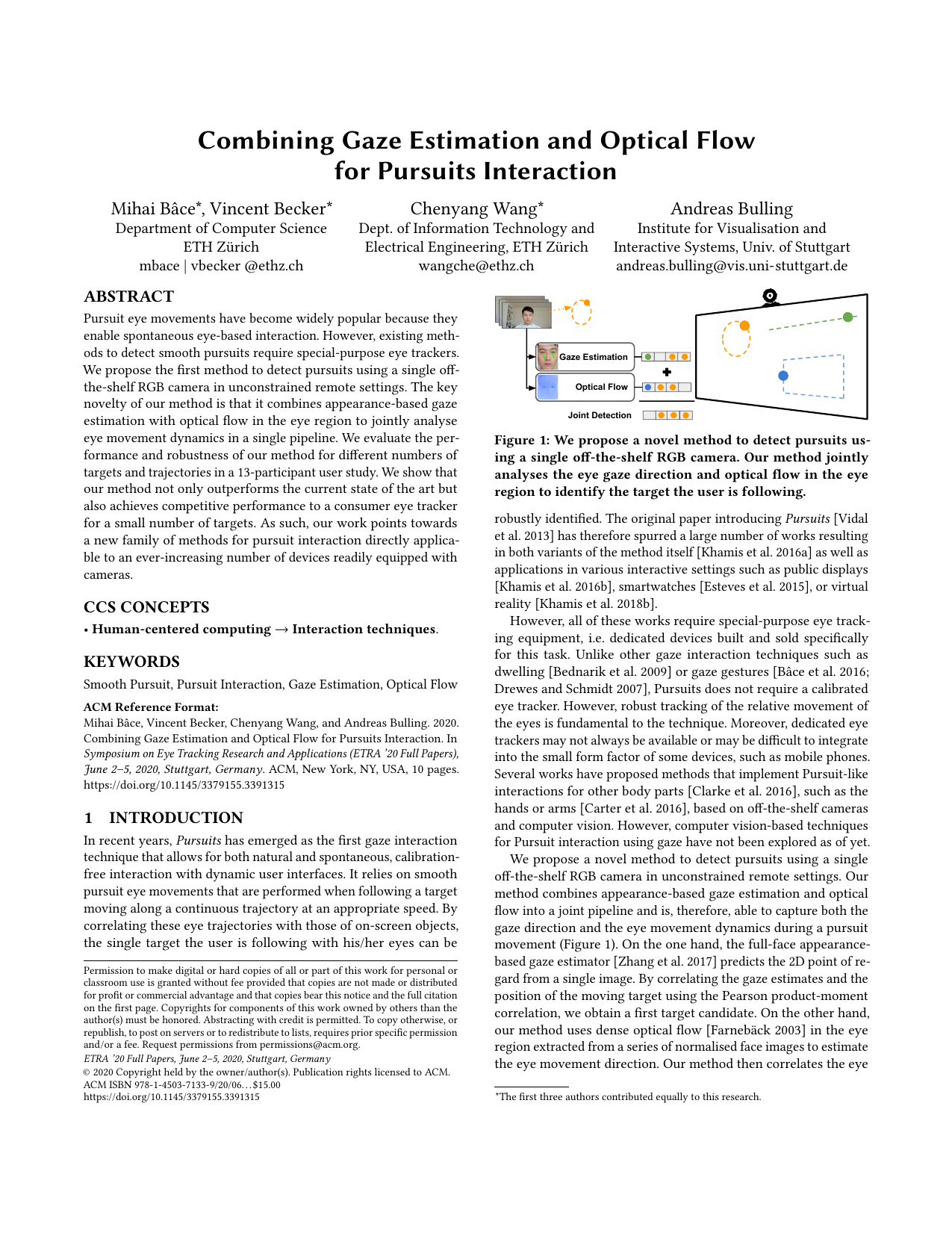
Pursuit eye movements have become widely popular because they enable spontaneous eye-based interaction. However, existing methods to detect smooth pursuits require special-purpose eye trackers. We propose the first method to detect pursuits using a single off-the-shelf RGB camera in unconstrained remote settings. The key novelty of our method is that it combines appearance-based gaze estimation with optical flow in the eye region to jointly analyse eye movement dynamics in a single pipeline. We evaluate the performance and robustness of our method for different numbers of targets and trajectories in a 13-participant user study. We show that our method not only outperforms the current state of the art but also achieves competitive performance to a consumer eye tracker for a small number of targets. As such, our work points towards a new family of methods for pursuit interaction directly applicable to an ever-increasing number of devices readily equipped with cameras.
@inproceedings{bace20_etra,
title = {Combining Gaze Estimation and Optical Flow for Pursuits Interaction},
author = {Mihai B{\^a}ce and Vincent Becker and Chenyang Wang and Andreas Bulling},
year = {2020},
booktitle = {Proc. ACM International Symposium on Eye Tracking Research and Applications (ETRA)},
pages = {1-10},
doi = {10.1145/3379155.3391315},
}
Anticipating Averted Gaze in Dyadic Interactions
Philipp Müller, Ekta Sood, Andreas Bulling
Proc. ACM International Symposium on Eye Tracking Research and Applications (ETRA), pp. 1-10, 2020.
AbstractLinksBibTeXProject
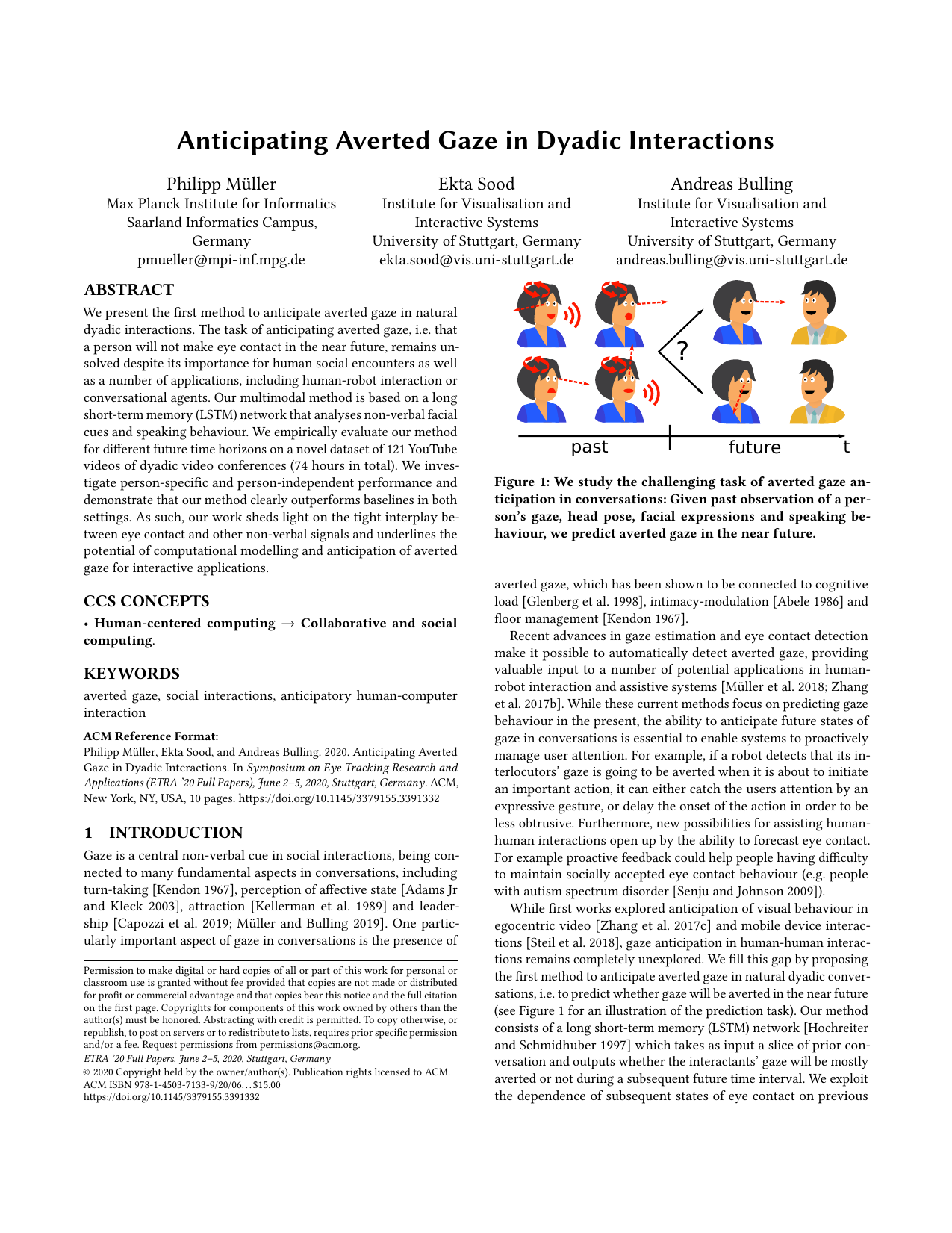
We present the first method to anticipate averted gaze in natural dyadic interactions. The task of anticipating averted gaze, i.e. that a person will not make eye contact in the near future, remains unsolved despite its importance for human social encounters as well as a number of applications, including human-robot interaction or conversational agents. Our multimodal method is based on a long short-term memory (LSTM) network that analyses non-verbal facial cues and speaking behaviour. We empirically evaluate our method for different future time horizons on a novel dataset of 121 YouTube videos of dyadic video conferences (74 hours in total). We investigate person-specific and person-independent performance and demonstrate that our method clearly outperforms baselines in both settings. As such, our work sheds light on the tight interplay between eye contact and other non-verbal signals and underlines the potential of computational modelling and anticipation of averted gaze for interactive applications.
@inproceedings{mueller20_etra,
title = {Anticipating Averted Gaze in Dyadic Interactions},
author = {Philipp Müller and Ekta Sood and Andreas Bulling},
year = {2020},
booktitle = {Proc. ACM International Symposium on Eye Tracking Research and Applications (ETRA)},
pages = {1-10},
doi = {10.1145/3379155.3391332},
}
Visual Analytics and Annotation of Pervasive Eye Tracking Video
Kuno Kurzhals, Nils Rodrigues, Maurice Koch, Michael Stoll, Andrés Bruhn, Andreas Bulling, Daniel Weiskopf
Proc. ACM International Symposium on Eye Tracking Research and Applications (ETRA), pp. 1-9, 2020.
AbstractLinksBibTeXProject
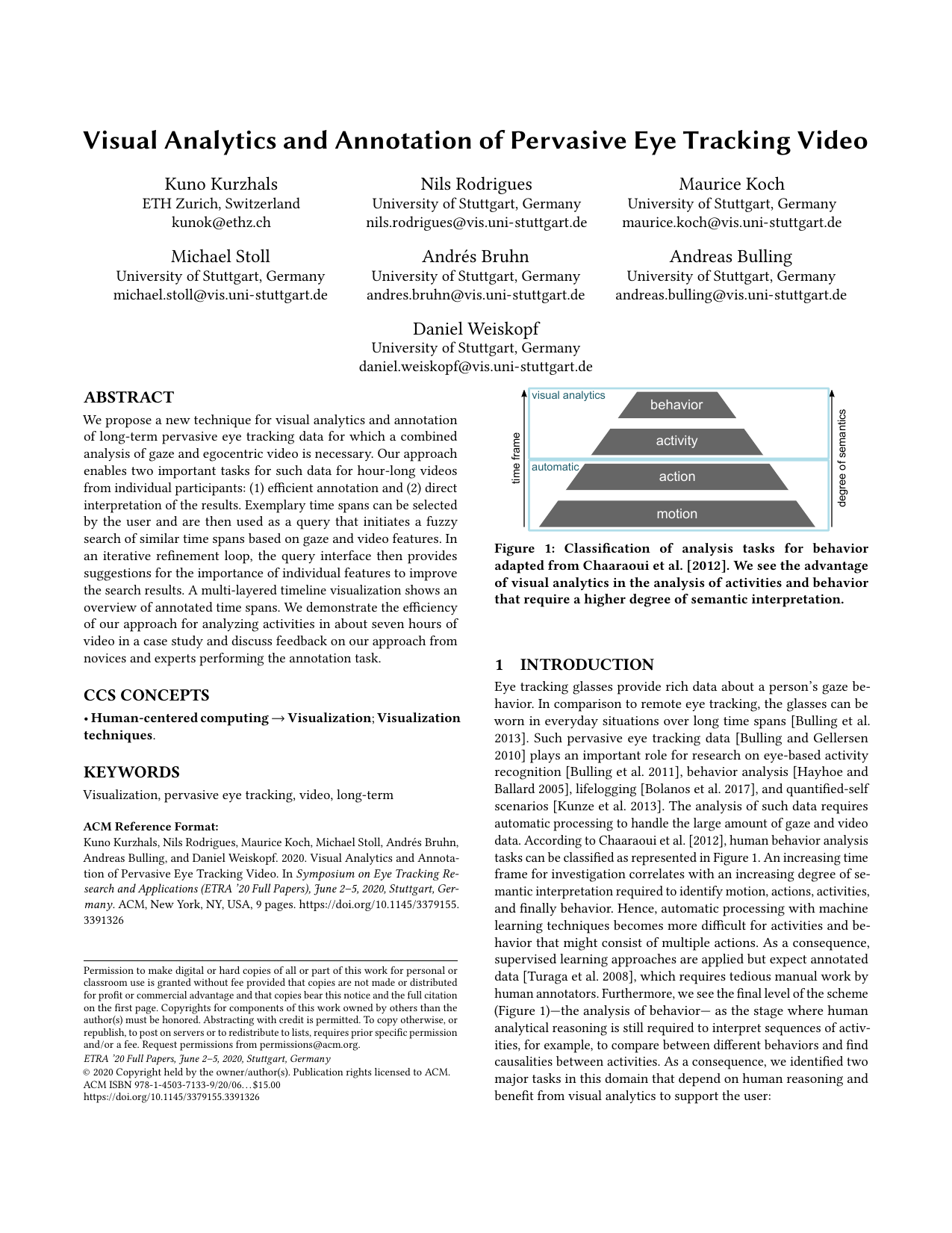
We propose a new technique for visual analytics and annotation of long-term pervasive eye tracking data for which a combined analysis of gaze and egocentric video is necessary. Our approach enables two important tasks for such data for hour-long videos from individual participants: (1) efficient annotation and (2) direct interpretation of the results. Exemplary time spans can be selected by the user and are then used as a query that initiates a fuzzy search of similar time spans based on gaze and video features. In an iterative refinement loop, the query interface then provides suggestions for the importance of individual features to improve the search results. A multi-layered timeline visualization shows an overview of annotated time spans. We demonstrate the efficiency of our approach for analyzing activities in about seven hours of video in a case study and discuss feedback on our approach from novices and experts performing the annotation task.
@inproceedings{kurzhals20_etra,
title = {Visual Analytics and Annotation of Pervasive Eye Tracking Video},
author = {Kuno Kurzhals and Nils Rodrigues and Maurice Koch and Michael Stoll and Andrés Bruhn and Andreas Bulling and Daniel Weiskopf},
year = {2020},
booktitle = {Proc. ACM International Symposium on Eye Tracking Research and Applications (ETRA)},
pages = {1-9},
doi = {10.1145/3379155.3391326},
}