Publications
2026
Mapping Frictions in Interdisciplinary Privacy Research: Evidence from Eye-Tracking Researchers
Susanne Hindennach, Mayar Elfares, Céline Gressel, Andreas Bulling
Human Centered Security Meets Social Sciences - Mapping the Frictions (SOUPS), 2026.
AbstractBibTeXProject
Friction between human-centred security researchers and social scientists is widely felt in interdisciplinary work, yet rarely documented empirically. Drawing on a study with eye-tracking researchers about privacy and ethics in sensitive data use, we present four points of friction extracted from both participant responses and our own research process: differences in terminology, assumptions, and values, as well as the hidden labour underlying interdisciplinary collaboration. We argue that these frictions are not merely obstacles but productive sites of reflection - and that addressing them requires making implicit assumptions explicit, disclosing disciplinary boundaries, and consciously harnessing the tensions they create.
@inproceedings{hindennach26_soups,
title = {{Mapping Frictions in Interdisciplinary Privacy Research}: {Evidence from Eye-Tracking Researchers}},
author = {Hindennach, Susanne and Elfares, Mayar and Gressel, Céline and Bulling, Andreas},
year = {2026},
booktitle = {Human Centered Security Meets Social Sciences - Mapping the Frictions (SOUPS)},
}
REFLECTing SPERET: Measuring and Promoting Ethics and Privacy Reflexivity in Eye-Tracking Research
Susanne Hindennach, Mayar Elfares, Céline Gressel, Andreas Bulling
Proc. International Conference on Science of Cyber Security (SciSec), 2026.
AbstractBibTeXProject
Reflexivity - critical awareness of methodological choices, assumptions, and positionality - is essential for robust research, particularly when data are context-dependent and interpretive. It helps address bias, privacy, fairness, and societal impact. We focus on these human aspects in eye tracking (ET), and on the researchers who design, interpret, and deploy these systems. We choose ET as a leading example, given the very important impact of researchers: ET data acquires meaning only through experimental design, theoretical assumptions, and analytic pipelines. Small methodological decisions can significantly shape conclusions. As ET integrates with AI and real-world applications, the researcher's role becomes even more consequential. Yet privacy-preserving techniques remain limited, despite eye-tracking data revealing sensitive information such as identity, health, or cognitive states. Adopting such techniques requires researchers' critical reflection on privacy and ethics, but reflexive practices are rarely formalised in ET. We introduce two complementary tools developed with over 60 researchers: REFLECT, a qualitative questionnaire, and SPERET, a validated psychometric scale. REFLECT enables in-depth questioning of privacy and ethics in small teams, while SPERET enables community-level comparisons. Using REFLECT, we reveal recurring assumptions about generalisability and competing values in handling sensitive data that explain limited adoption of privacy techniques. SPERET operationalises these findings and consistently measures reflexivity. Together, our tools provide empirical insights into ethical reasoning and concrete instruments to promote more privacy- and ethics-conscious research practice at individual and community levels.
@inproceedings{hindennach26_scisec,
title = {{{REFLECTing SPERET}}: {{Measuring}} and {{Promoting Ethics}} and {{Privacy Reflexivity}} in {{Eye-Tracking Research}}},
author = {Hindennach, Susanne and Elfares, Mayar and Gressel, C{\'e}line and Bulling, Andreas},
year = {2026},
booktitle = {Proc. International Conference on Science of Cyber Security (SciSec)},
shorttitle = {{REFLECTing SPERET}},
}
2025

REFLECTing SPERET: Measuring and Promoting Ethics and Privacy Reflexivity in Eye-Tracking Research
Susanne Hindennach, Mayar Elfares, Céline Gressel, Andreas Bulling
arXiv:2511.18965, 2025.
AbstractLinksBibTeXProject
The proliferation of eye tracking in high-stakes domains - such as healthcare, marketing and surveillance - underscores the need for researchers to be ethically aware when employing this technology. Although privacy and ethical guidelines have emerged in recent years, empirical research on how scholars reflect on their own work remains scarce. To address this gap, we present two complementary instruments developed with input from more than 70 researchers: REFLECT, a qualitative questionnaire, and SPERET (Latin for "hope"), a quantitative psychometric scale that measures privacy and ethics reflexivity in eye tracking. Our findings reveal a research community that is concerned about user privacy, cognisant of methodological constraints, such as sample bias, and that possesses a nuanced sense of ethical responsibility evolving with project maturity. Together, these tools and our analyses offer a systematic examination and a hopeful outlook on reflexivity in eye-tracking research, promoting more privacy and ethics-conscious practice.
@techreport{hindennach25_arxiv,
title = {{{REFLECTing SPERET}}: {{Measuring}} and {{Promoting Ethics}} and {{Privacy Reflexivity}} in {{Eye-Tracking Research}}},
author = {Hindennach, Susanne and Elfares, Mayar and Gressel, C{\'e}line and Bulling, Andreas},
year = {2025},
doi = {10.48550/arXiv.2511.18965},
publisher = {arXiv},
shorttitle = {{REFLECTing SPERET}},
}
2024
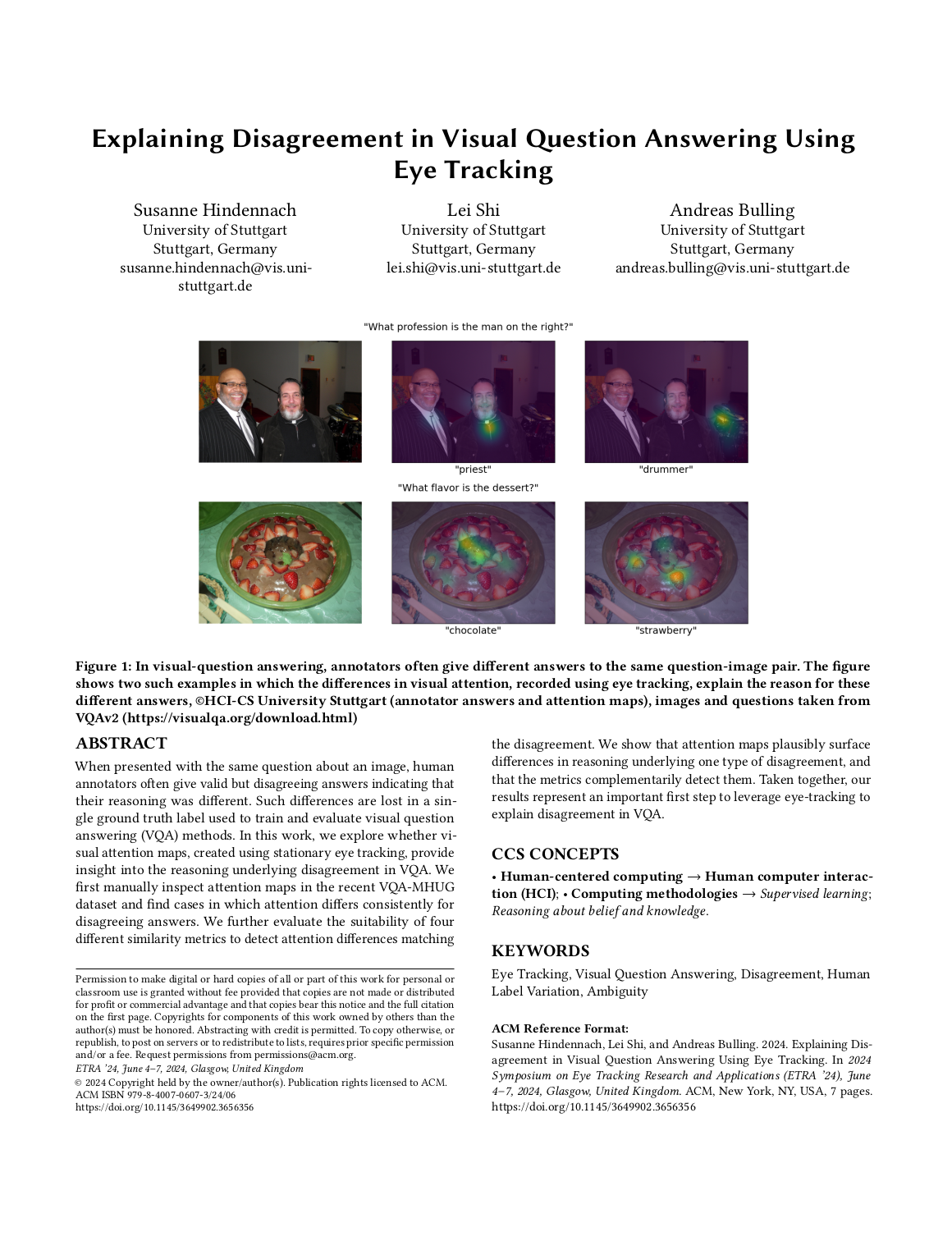
Explaining Disagreement in Visual Question Answering Using Eye Tracking
Susanne Hindennach, Lei Shi, Andreas Bulling
Proc. International Workshop on Pervasive Eye Tracking and Mobile Gaze-Based Interaction (PETMEI), pp. 1--7, 2024.
AbstractLinksBibTeXProject
When presented with the same question about an image, human annotators often give valid but disagreeing answers indicating that their reasoning was different. Such differences are lost in a single ground truth label used to train and evaluate visual question answering (VQA) methods. In this work, we explore whether visual attention maps, created using stationary eye tracking, provide insight into the reasoning underlying disagreement in VQA. We first manually inspect attention maps in the recent VQA-MHUG dataset and find cases in which attention differs consistently for disagreeing answers. We further evaluate the suitability of four different similarity metrics to detect attention differences matching the disagreement. We show that attention maps plausibly surface differences in reasoning underlying one type of disagreement, and that the metrics complementarily detect them. Taken together, our results represent an important first step to leverage eye-tracking to explain disagreement in VQA.
@inproceedings{hindennach24_petmei,
title = {Explaining Disagreement in Visual Question Answering Using Eye Tracking},
author = {Susanne Hindennach and Lei Shi and Andreas Bulling},
year = {2024},
booktitle = {Proc. International Workshop on Pervasive Eye Tracking and Mobile Gaze-Based Interaction (PETMEI)},
pages = {1--7},
doi = {10.1145/3649902.3656356},
}
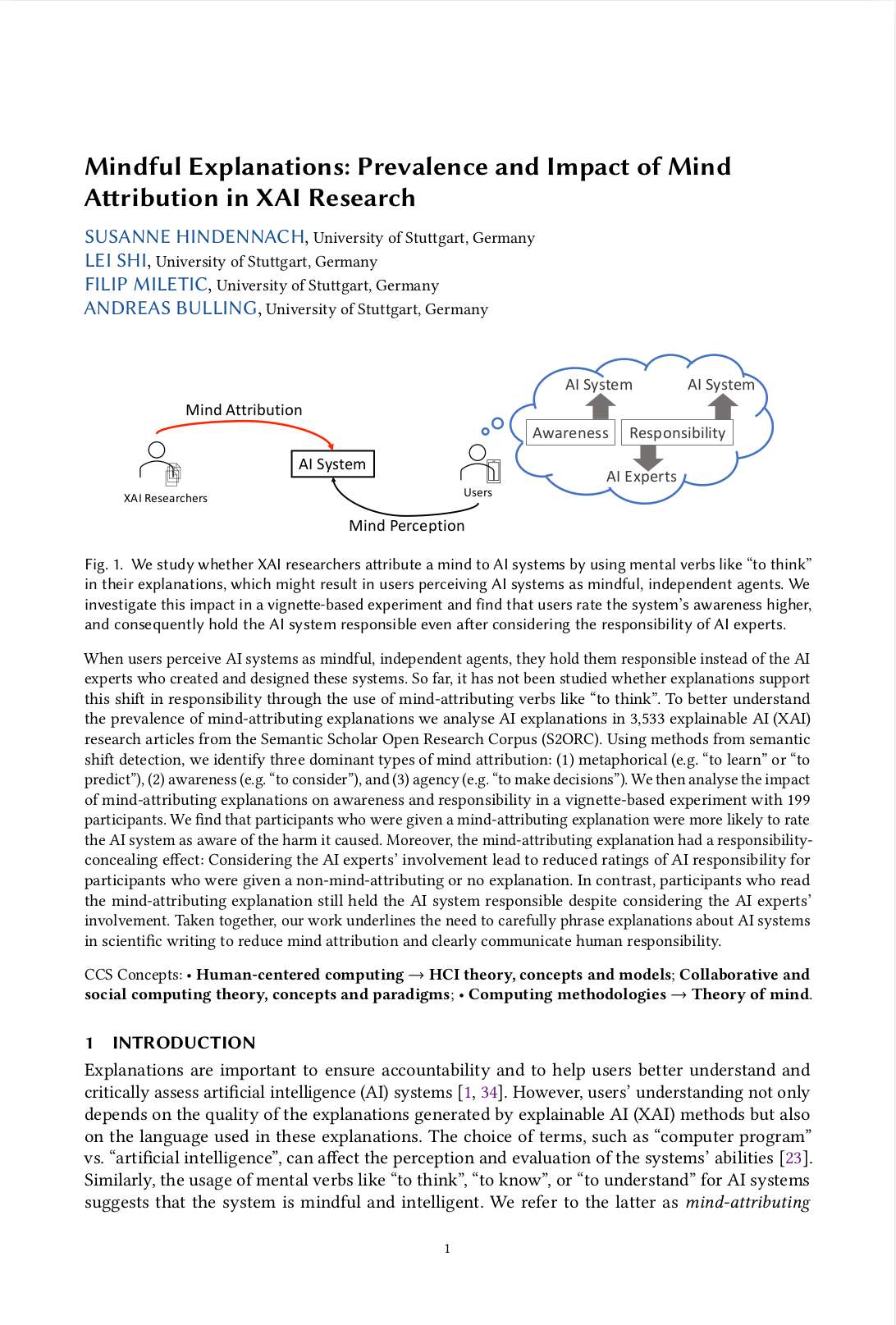
Mindful Explanations: Prevalence and Impact of Mind Attribution in XAI Research
Susanne Hindennach, Lei Shi, Filip Miletic, Andreas Bulling
Proc. ACM on Human-Computer Interaction (PACM HCI), 8 (CSCW), pp. 1--42, 2024.
AbstractLinksBibTeXProject Best Paper Honourable Mention Award
When users perceive AI systems as mindful, independent agents, they hold them responsible instead of the AI experts who created and designed these systems. So far, it has not been studied whether explanations support this shift in responsibility through the use of mind-attributing verbs like "to think". To better understand the prevalence of mind-attributing explanations we analyse AI explanations in 3,533 explainable AI (XAI) research articles from the Semantic Scholar Open Research Corpus (S2ORC). Using methods from semantic shift detection, we identify three dominant types of mind attribution: (1) metaphorical (e.g. "to learn" or "to predict"), (2) awareness (e.g. "to consider"), and (3) agency (e.g. "to make decisions"). We then analyse the impact of mind-attributing explanations on awareness and responsibility in a vignette-based experiment with 199 participants. We find that participants who were given a mind-attributing explanation were more likely to rate the AI system as aware of the harm it caused. Moreover, the mind-attributing explanation had a responsibility-concealing effect: Considering the AI experts’ involvement lead to reduced ratings of AI responsibility for participants who were given a non-mind-attributing or no explanation. In contrast, participants who read the mind-attributing explanation still held the AI system responsible despite considering the AI experts’ involvement. Taken together, our work underlines the need to carefully phrase explanations about AI systems in scientific writing to reduce mind attribution and clearly communicate human responsibility.
@article{hindennach24_pacm,
title = {Mindful Explanations: Prevalence and Impact of Mind Attribution in XAI Research},
author = {Susanne Hindennach and Lei Shi and Filip Miletic and Andreas Bulling},
year = {2024},
journal = {Proc. ACM on Human-Computer Interaction (PACM HCI)},
volume = {8},
number = {CSCW},
pages = {1--42},
doi = {10.1145/3641009},
url = {https://medium.com/acm-cscw/be-mindful-when-using-mindful-descriptions-in-explanations-about-ai-bfc7666885c6},
}
2022

Predicting Next Actions and Latent Intents during Text Formatting
Guanhua Zhang, Susanne Hindennach, Jan Leusmann, Felix Bühler, Benedict Steuerlein, Sven Mayer, Mihai Bâce, Andreas Bulling
Proc. the CHI Workshop Computational Approaches for Understanding, Generating, and Adapting User Interfaces, pp. 1--6, 2022.
AbstractLinksBibTeXProject
In this work we investigate the challenging task of predicting user intents from mouse and keyboard input as well as gaze behaviour. In contrast to prior work we study intent prediction at two different resolutions on the behavioural timeline: predicting future input actions as well as latent intents to achieve a high-level interaction goal. Results from a user study (N=15) on a sample text formatting task show that the sequence of prior actions is more informative for intent prediction than gaze. Only using the action sequence, we can predict the next action and the high-level intent with an accuracy of 66% and 96%, respectively. In contrast, accuracy when using features extracted from gaze behaviour was significantly lower, at 41% and 46%. This finding is important for the development of future anticipatory user interfaces that aim to proactively adapt to user intents and interaction goals.
@inproceedings{zhang22_caugaui,
title = {Predicting Next Actions and Latent Intents during Text Formatting},
author = {Guanhua Zhang and Susanne Hindennach and Jan Leusmann and Felix Bühler and Benedict Steuerlein and Sven Mayer and Mihai Bâce and Andreas Bulling},
year = {2022},
booktitle = {Proc. the CHI Workshop Computational Approaches for Understanding, Generating, and Adapting User Interfaces},
pages = {1--6},
}


