PrivacEye: Privacy-Preserving Head-Mounted Eye Tracking Using Egocentric Scene Image and Eye Movement Features
Julian Steil, Marion Koelle, Wilko Heuten, Susanne Boll, Andreas Bulling
Proc. ACM International Symposium on Eye Tracking Research and Applications (ETRA), pp. 1--10, 2019.
AbstractLinksBibTeXProject Best Video Award
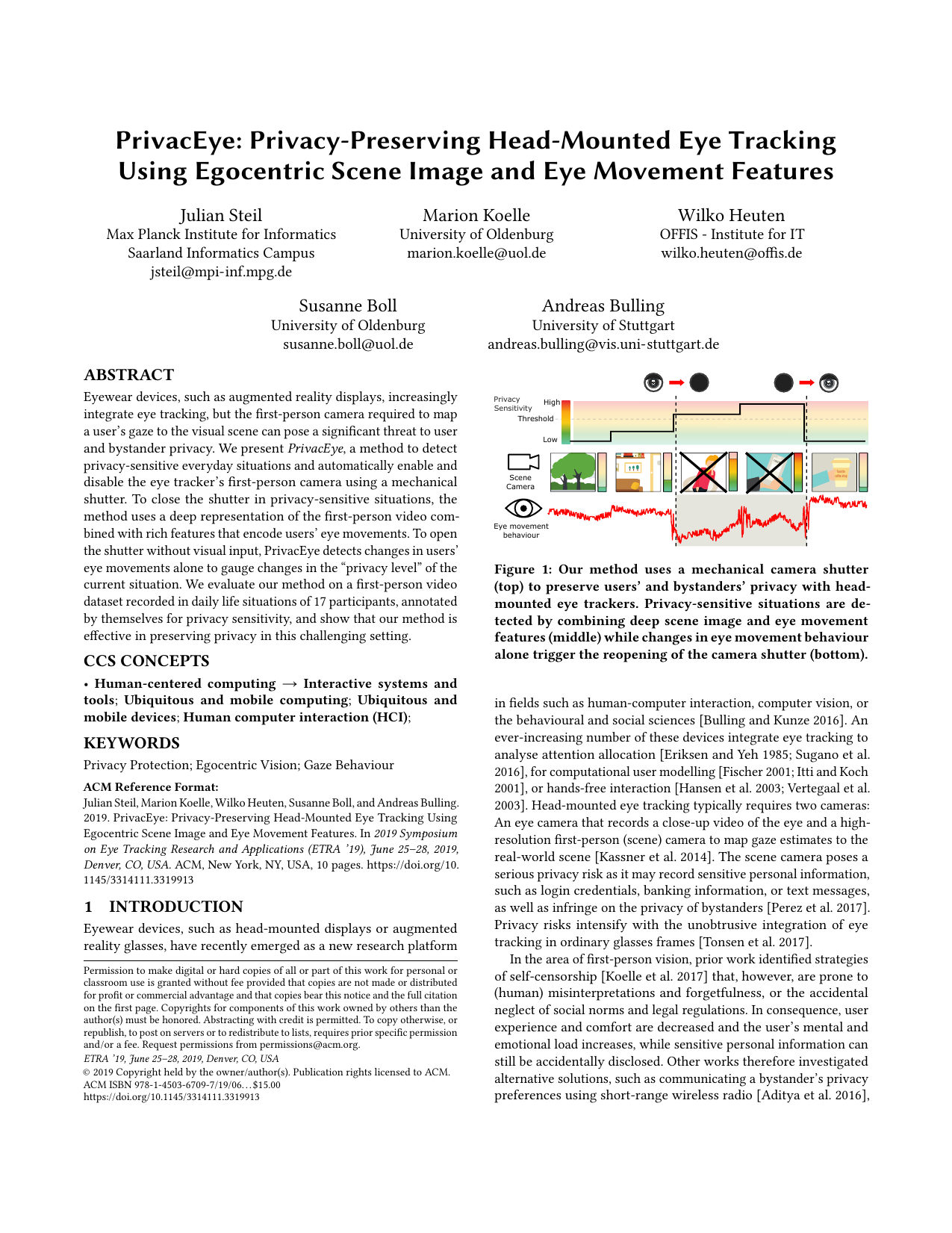
Eyewear devices, such as augmented reality displays, increasingly integrate eye tracking but the first-person camera required to map a user's gaze to the visual scene can pose a significant threat to user and bystander privacy. We present PrivacEye, a method to detect privacy-sensitive everyday situations and automatically enable and disable the eye tracker's first-person camera using a mechanical shutter. To close the shutter in privacy-sensitive situations, the method uses a deep representation of the first-person video combined with rich features that encode users' eye movements. To open the shutter without visual input, PrivacEye detects changes in users' eye movements alone to gauge changes in the "privacy level" of the current situation. We evaluate our method on a first-person video dataset recorded in daily life situations of 17 participants, annotated by themselves for privacy sensitivity, and show that our method is effective in preserving privacy in this challenging setting.
@inproceedings{steil19_etra,
title = {PrivacEye: Privacy-Preserving Head-Mounted Eye Tracking Using Egocentric Scene Image and Eye Movement Features},
author = {Julian Steil and Marion Koelle and Wilko Heuten and Susanne Boll and Andreas Bulling},
year = {2019},
booktitle = {Proc. ACM International Symposium on Eye Tracking Research and Applications (ETRA)},
pages = {1--10},
doi = {10.1145/3314111.3319913},
video = {https://www.youtube.com/watch?v=Gy61255F8T8},
}
Privacy-Aware Eye Tracking Using Differential Privacy
Julian Steil, Inken Hagestedt, Michael Xuelin Huang, Andreas Bulling
Proc. ACM International Symposium on Eye Tracking Research and Applications (ETRA), pp. 1--9, 2019.
AbstractLinksBibTeXProject Best Paper Award
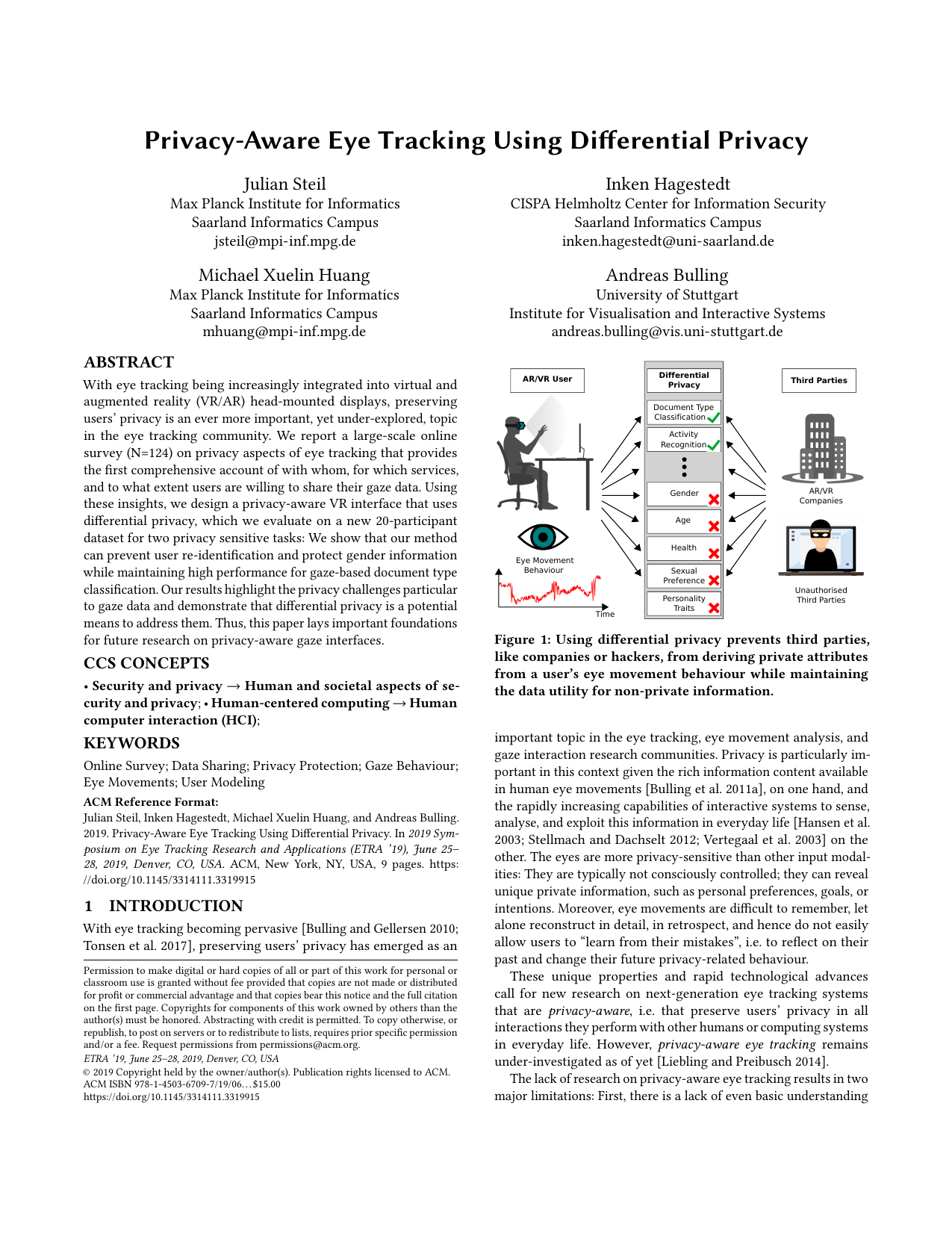
With eye tracking being increasingly integrated into virtual and augmented reality (VR/AR) head-mounted displays, preserving users' privacy is an ever more important, yet under-explored, topic in the eye tracking community. We report a large-scale online survey (N=124) on privacy aspects of eye tracking that provides the first comprehensive account of with whom, for which services, and to which extent users are willing to share their gaze data. Using these insights, we design a privacy-aware VR interface that uses differential privacy, which we evaluate on a new 20-participant dataset for two privacy sensitive tasks: We show that our method can prevent user re-identification and protect gender information while maintaining high performance for gaze-based document type classification. Our results highlight the privacy challenges particular to gaze data and demonstrate that differential privacy is a potential means to address them. Thus, this paper lays important foundations for future research on privacy-aware gaze interfaces.
@inproceedings{steil19_etra_2,
title = {Privacy-Aware Eye Tracking Using Differential Privacy},
author = {Julian Steil and Inken Hagestedt and Michael Xuelin Huang and Andreas Bulling},
year = {2019},
booktitle = {Proc. ACM International Symposium on Eye Tracking Research and Applications (ETRA)},
pages = {1--9},
doi = {10.1145/3314111.3319915},
}
Reducing Calibration Drift in Mobile Eye Trackers by Exploiting Mobile Phone Usage
Philipp Müller, Daniel Buschek, Michael Xuelin Huang, Andreas Bulling
Proc. ACM International Symposium on Eye Tracking Research and Applications (ETRA), pp. 1--9, 2019.
AbstractLinksBibTeXProject
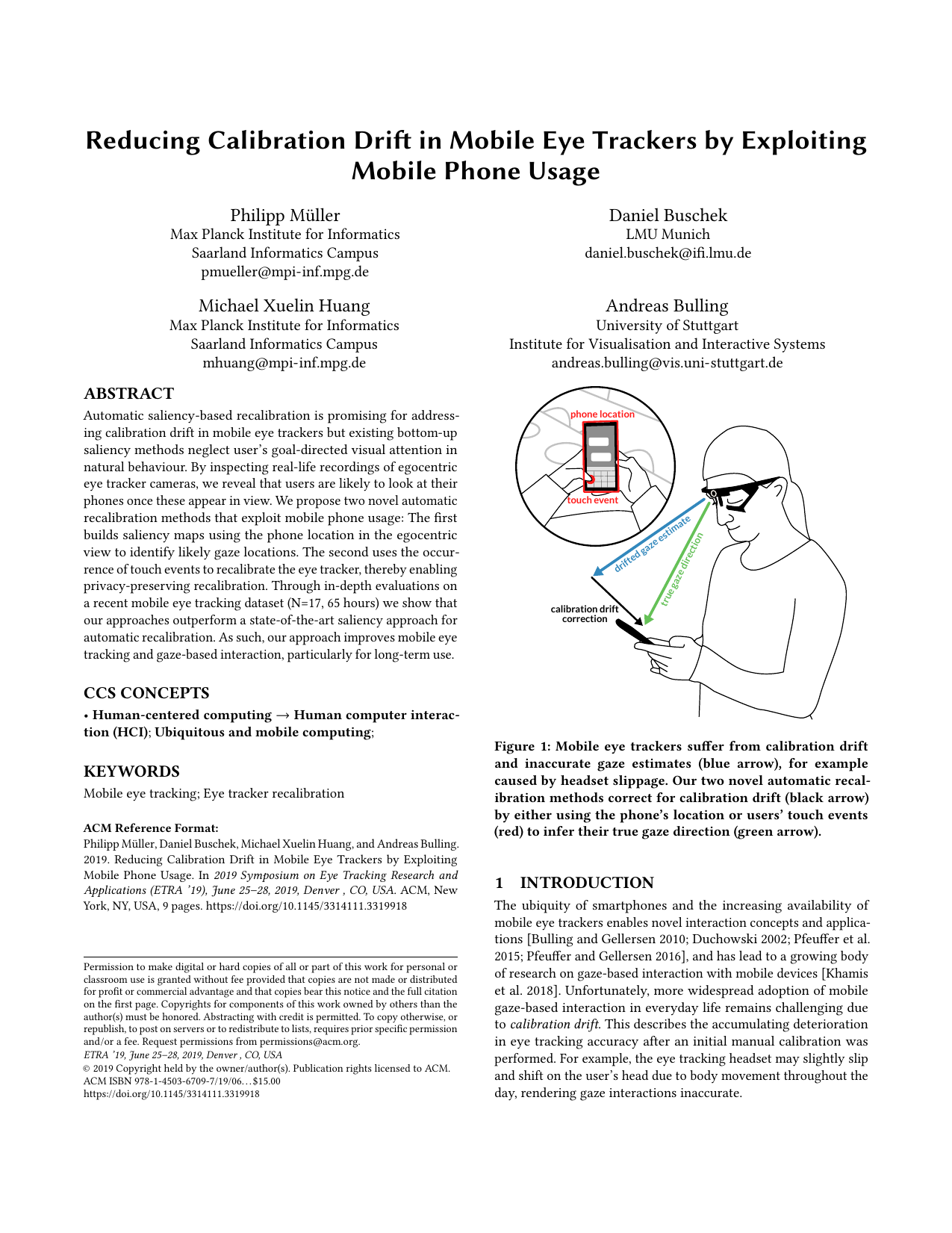
Automatic saliency-based recalibration is promising for addressing calibration drift in mobile eye trackers but existing bottom-up saliency methods neglect user's goal-directed visual attention in natural behaviour. By inspecting real-life recordings of egocentric eye tracker cameras, we reveal that users are likely to look at their phones once these appear in view. We propose two novel automatic recalibration methods that exploit mobile phone usage: The first builds saliency maps using the phone location in the egocentric view to identify likely gaze locations. The second uses the occurrence of touch events to recalibrate the eye tracker, thereby enabling privacy-preserving recalibration. Through in-depth evaluations on a recent mobile eye tracking dataset (N=17, 65 hours) we show that our approaches outperform a state-of-the-art saliency approach for the automatic recalibration task. As such, our approach improves mobile eye tracking and gaze-based interaction, particularly for long-term use.
@inproceedings{mueller19_etra,
title = {Reducing Calibration Drift in Mobile Eye Trackers by Exploiting Mobile Phone Usage},
author = {Philipp M{\"{u}}ller and Daniel Buschek and Michael Xuelin Huang and Andreas Bulling},
year = {2019},
booktitle = {Proc. ACM International Symposium on Eye Tracking Research and Applications (ETRA)},
pages = {1--9},
doi = {10.1145/3314111.3319918},
}
A fast approach to refraction-aware 3D eye-model fitting and gaze prediction
Kai Dierkes, Moritz Kassner, Andreas Bulling
Proc. ACM International Symposium on Eye Tracking Research and Applications (ETRA), pp. 1--9, 2019.
AbstractLinksBibTeXProject
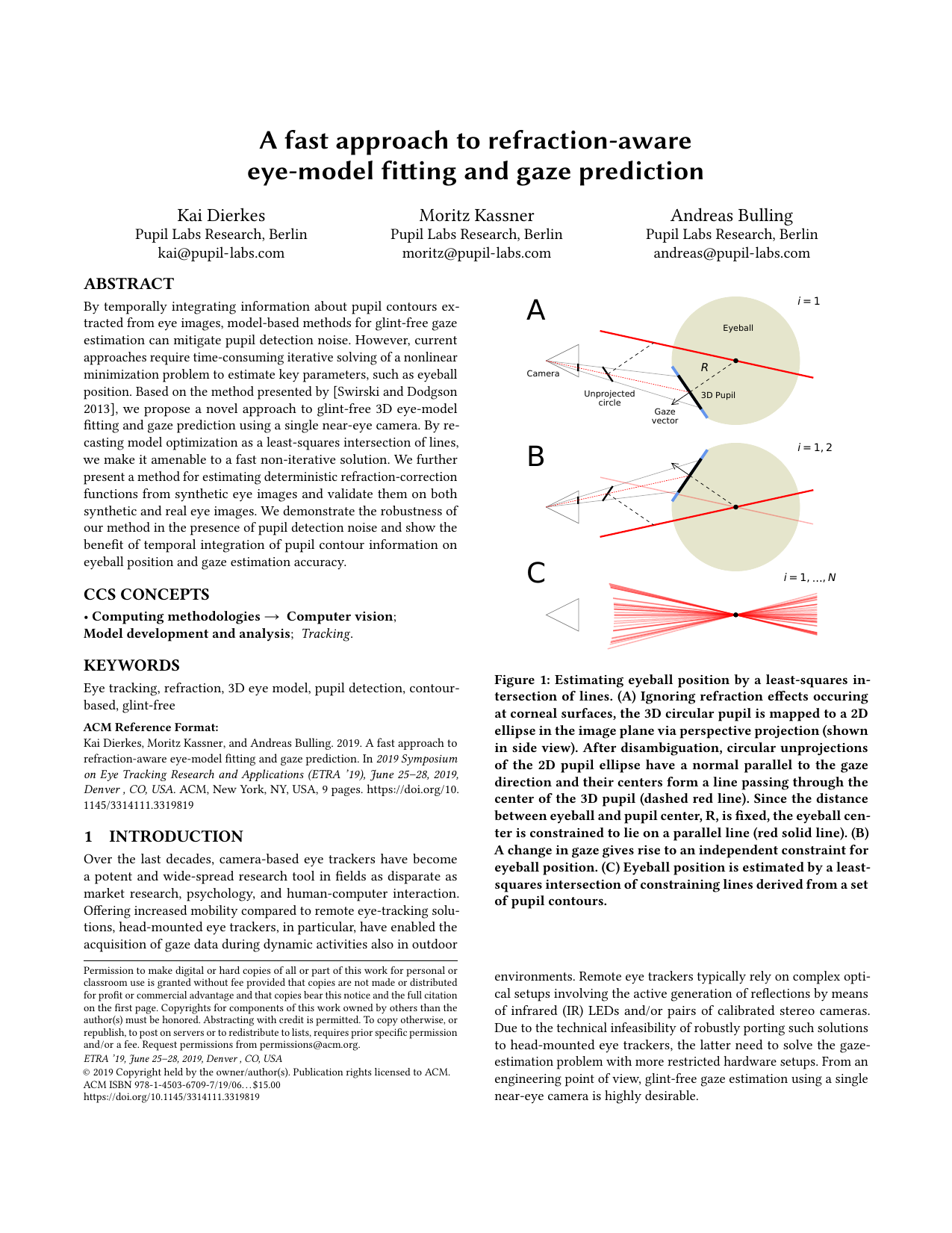
By temporally integrating information about pupil contours extracted from eye images, model-based methods for glint-free gaze estimation can mitigate pupil detection noise. However, current approaches require time-consuming iterative solving of a nonlinear minimization problem to estimate key parameters, such as eyeball position. Based on the method presented by [Swirski and Dodgson 2013], we propose a novel approach to glint-free 3D eye-model fitting and gaze prediction using a single near-eye camera. By recasting model optimization as a least-squares intersection of lines, we make it amenable to a fast non-iterative solution. We further present a method for estimating deterministic refraction-correction functions from synthetic eye images and validate them on both synthetic and real eye images. We demonstrate the robustness of our method in the presence of pupil detection noise and show the benefit of temporal integration of pupil contour information on eyeball position and gaze estimation accuracy.
@inproceedings{dierkes19_etra,
title = {A fast approach to refraction-aware 3D eye-model fitting and gaze prediction},
author = {Kai Dierkes and Moritz Kassner and Andreas Bulling},
year = {2019},
booktitle = {Proc. ACM International Symposium on Eye Tracking Research and Applications (ETRA)},
pages = {1--9},
doi = {10.1145/3314111.3319819},
}
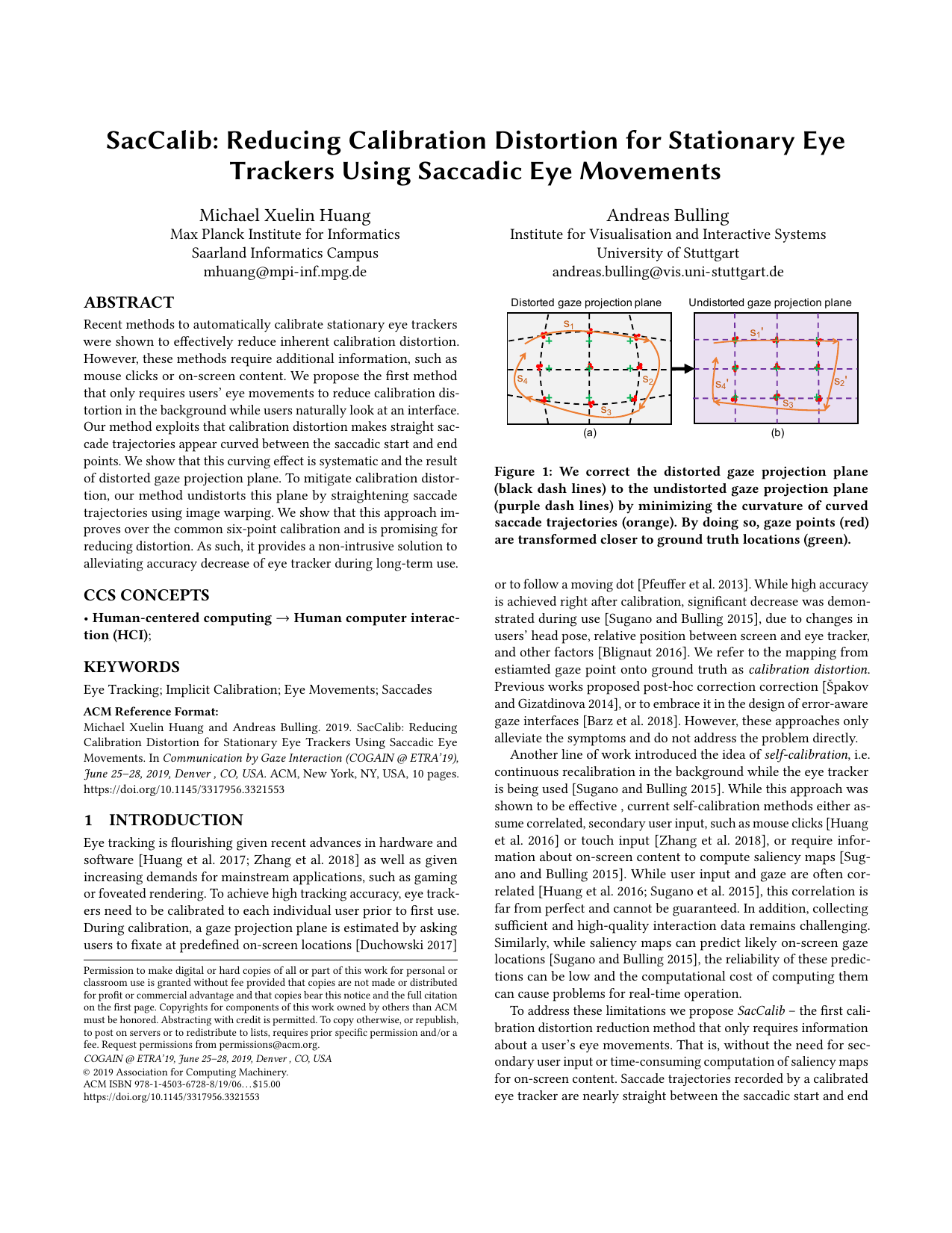
SacCalib: Reducing Calibration Distortion for Stationary Eye Trackers Using Saccadic Eye Movements
Michael Xuelin Huang, Andreas Bulling
Proc. ACM International Symposium on Eye Tracking Research and Applications (ETRA), pp. 1--10, 2019.
AbstractLinksBibTeXProject
Recent methods to automatically calibrate stationary eye trackers were shown to effectively reduce inherent calibration distortion. However, these methods require additional information, such as mouse clicks or on-screen content. We propose the first method that only requires users' eye movements to reduce calibration distortion in the background while users naturally look at an interface. Our method exploits that calibration distortion makes straight saccade trajectories appear curved between the saccadic start and end points. We show that this curving effect is systematic and the result of a distorted gaze projection plane. To mitigate calibration distortion, our method undistorts this plane by straightening saccade trajectories using image warping. We show that this approach improves over the common six-point calibration and is promising for reducing distortion. As such, it provides a non-intrusive solution to alleviating accuracy decrease of eye tracker during long-term use.
@inproceedings{huang19_etra,
title = {SacCalib: Reducing Calibration Distortion for Stationary Eye Trackers Using Saccadic Eye Movements},
author = {Michael Xuelin Huang and Andreas Bulling},
year = {2019},
booktitle = {Proc. ACM International Symposium on Eye Tracking Research and Applications (ETRA)},
pages = {1--10},
doi = {0.1145/3317956.3321553},
}