Publications
2024
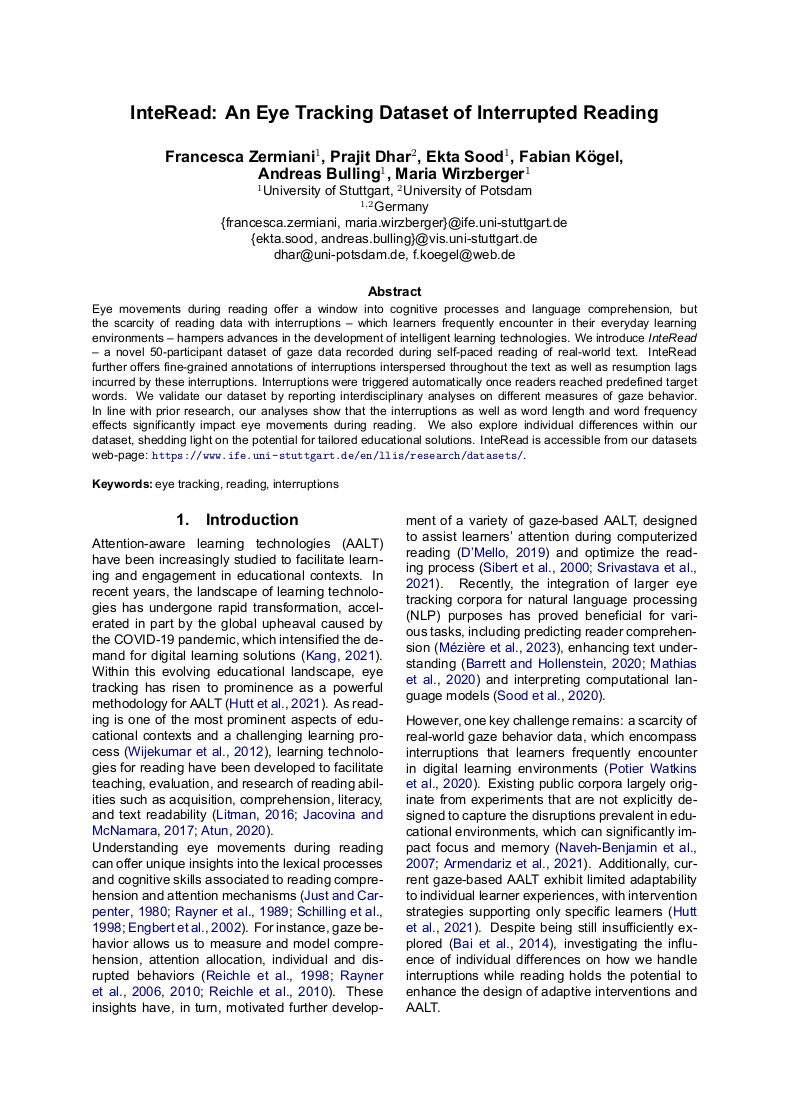
InteRead: An Eye Tracking Dataset of Interrupted Reading
Francesca Zermiani, Prajit Dhar, Ekta Sood, Fabian Kögel, Andreas Bulling, Maria Wirzberger
Proc. 31st Joint International Conference on Computational Linguistics, Language Resources and Evaluation (LREC-COLING), pp. 9154--9169, 2024.
AbstractLinksBibTeXProject
Eye movements during reading offer a window into cognitive processes and language comprehension, but the scarcity of reading data with interruptions – which learners frequently encounter in their everyday learning environments – hampers advances in the development of intelligent learning technologies. We introduce InteRead – a novel 50-participant dataset of gaze data recorded during self-paced reading of real-world text. InteRead further offers fine-grained annotations of interruptions interspersed throughout the text as well as resumption lags incurred by these interruptions. Interruptions were triggered automatically once readers reached predefined target words. We validate our dataset by reporting interdisciplinary analyses on different measures of gaze behavior. In line with prior research, our analyses show that the interruptions as well as word length and word frequency effects significantly impact eye movements during reading. We also explore individual differences within our dataset, shedding light on the potential for tailored educational solutions. InteRead is accessible from our datasets web-page: https://www.ife.uni-stuttgart.de/en/llis/research/datasets/.
@inproceedings{zermiani24_coling,
title = {InteRead: An Eye Tracking Dataset of Interrupted Reading},
author = {Francesca Zermiani and Prajit Dhar and Ekta Sood and Fabian Kögel and Andreas Bulling and Maria Wirzberger},
year = {2024},
booktitle = {Proc. 31st Joint International Conference on Computational Linguistics, Language Resources and Evaluation (LREC-COLING)},
pages = {9154--9169},
url = {https://aclanthology.org/2024.lrec-main.802/},
}
2023
Towards Robust FastSpeech 2 by Modelling Residual Multimodality
Fabian Kögel, Bac Nguyen, Fabien Cardinaux
Proc. INTERSPEECH 2023, pp. 4309--4313, 2023.
AbstractLinksBibTeXProject SL1 Special Recognition (Best Publication) Award
State-of-the-art non-autoregressive text-to-speech (TTS) models based on FastSpeech 2 can efficiently synthesise high-fidelity and natural speech. For expressive speech datasets however, we observe characteristic audio distortions. We demonstrate that such artefacts are introduced to the vocoder reconstruction by over-smooth mel-spectrogram predictions, which are induced by the choice of mean-squared-error (MSE) loss for training the mel-spectrogram decoder. With MSE loss FastSpeech 2 is limited to learn conditional averages of the training distribution, which might not lie close to a natural sample if the distribution still appears multimodal after all conditioning signals. To alleviate this problem, we introduce TVC-GMM, a mixture model of Trivariate-Chain Gaussian distributions, to model the residual multimodality. TVC-GMM reduces spectrogram smoothness and improves perceptual audio quality in particular for expressive datasets as shown by both objective and subjective evaluation.
@inproceedings{kogel23_interspeech,
title = {{Towards Robust FastSpeech 2 by Modelling Residual Multimodality}},
author = {Fabian Kögel and Bac Nguyen and Fabien Cardinaux},
year = {2023},
booktitle = {Proc. INTERSPEECH 2023},
pages = {4309--4313},
doi = {10.21437/Interspeech.2023-879},
}
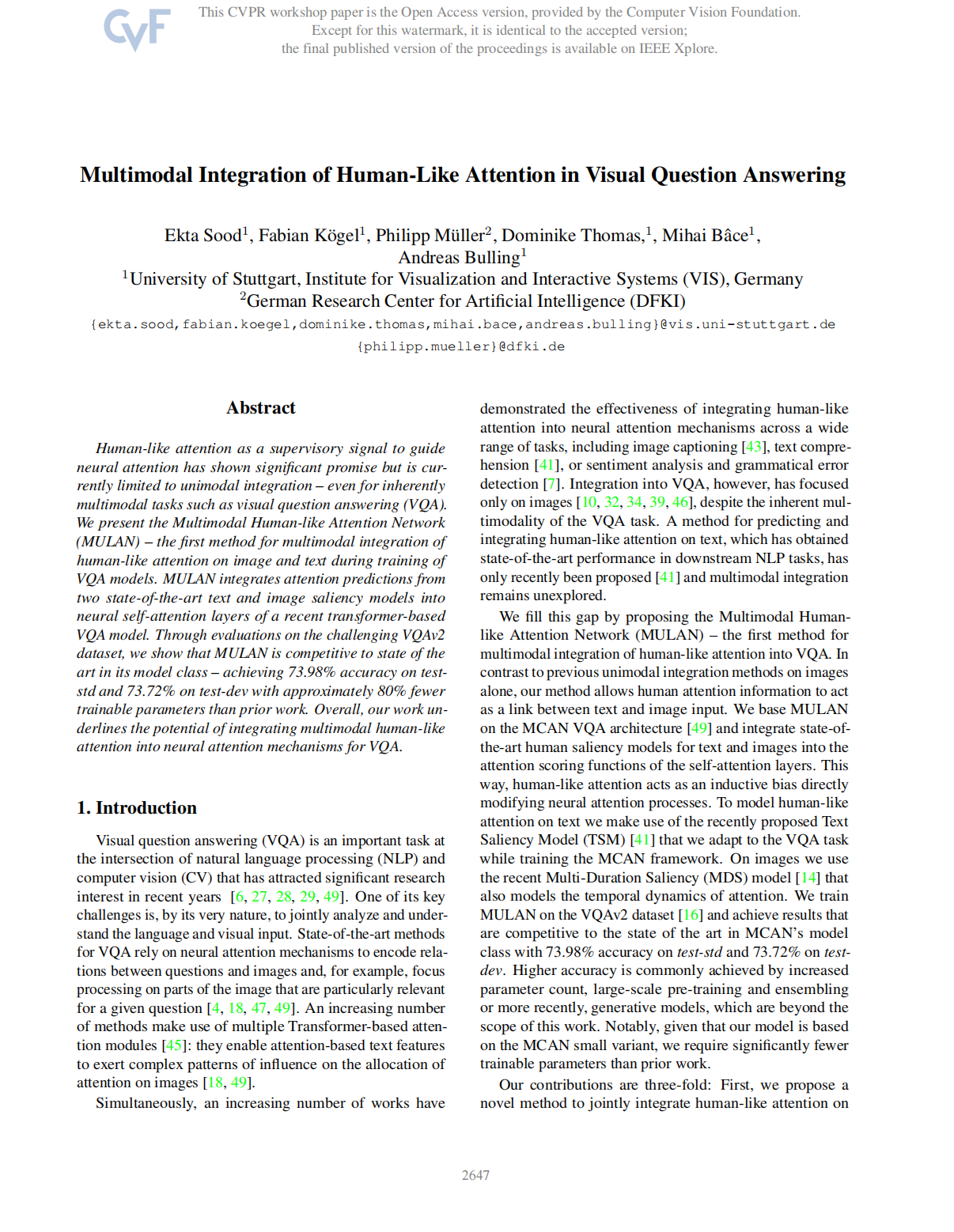
Multimodal Integration of Human-Like Attention in Visual Question Answering
Ekta Sood, Fabian Kögel, Philipp Müller, Dominike Thomas, Mihai Bâce, Andreas Bulling
Proc. Workshop on Gaze Estimation and Prediction in the Wild (GAZE), CVPRW, pp. 2647--2657, 2023.
AbstractLinksBibTeXProject Tobii Sponsor Award, Oral Presentation
Human-like attention as a supervisory signal to guide neural attention has shown significant promise but is currently limited to uni-modal integration – even for inherently multi-modal tasks such as visual question answering (VQA). We present the Multimodal Human-like Attention Network (MULAN) – the first method for multimodal integration of human-like attention on image and text during training of VQA models. MULAN integrates attention predictions from two state-of-the-art text and image saliency models into neural self-attention layers of a recent transformer-based VQA model. Through evaluations on the challenging VQAv2 dataset, we show that MULAN achieves a new state-of-the-art performance of 73.98% accuracy on test-std and 73.72% on test-dev and, at the same time, has approximately 80% fewer trainable parameters than prior work. Overall, our work underlines the potential of integrating multimodal human-like and neural attention for VQA.
@inproceedings{sood23_gaze,
title = {Multimodal Integration of Human-Like Attention in Visual Question Answering},
author = {Sood, Ekta and Fabian Kögel and Philipp Müller and Dominike Thomas and Mihai Bâce and Andreas Bulling},
year = {2023},
booktitle = {Proc. Workshop on Gaze Estimation and Prediction in the Wild (GAZE), CVPRW},
pages = {2647--2657},
url = {https://openaccess.thecvf.com/content/CVPR2023W/GAZE/papers/Sood_Multimodal_Integration_of_Human-Like_Attention_in_Visual_Question_Answering_CVPRW_2023_paper.pdf},
}
2021
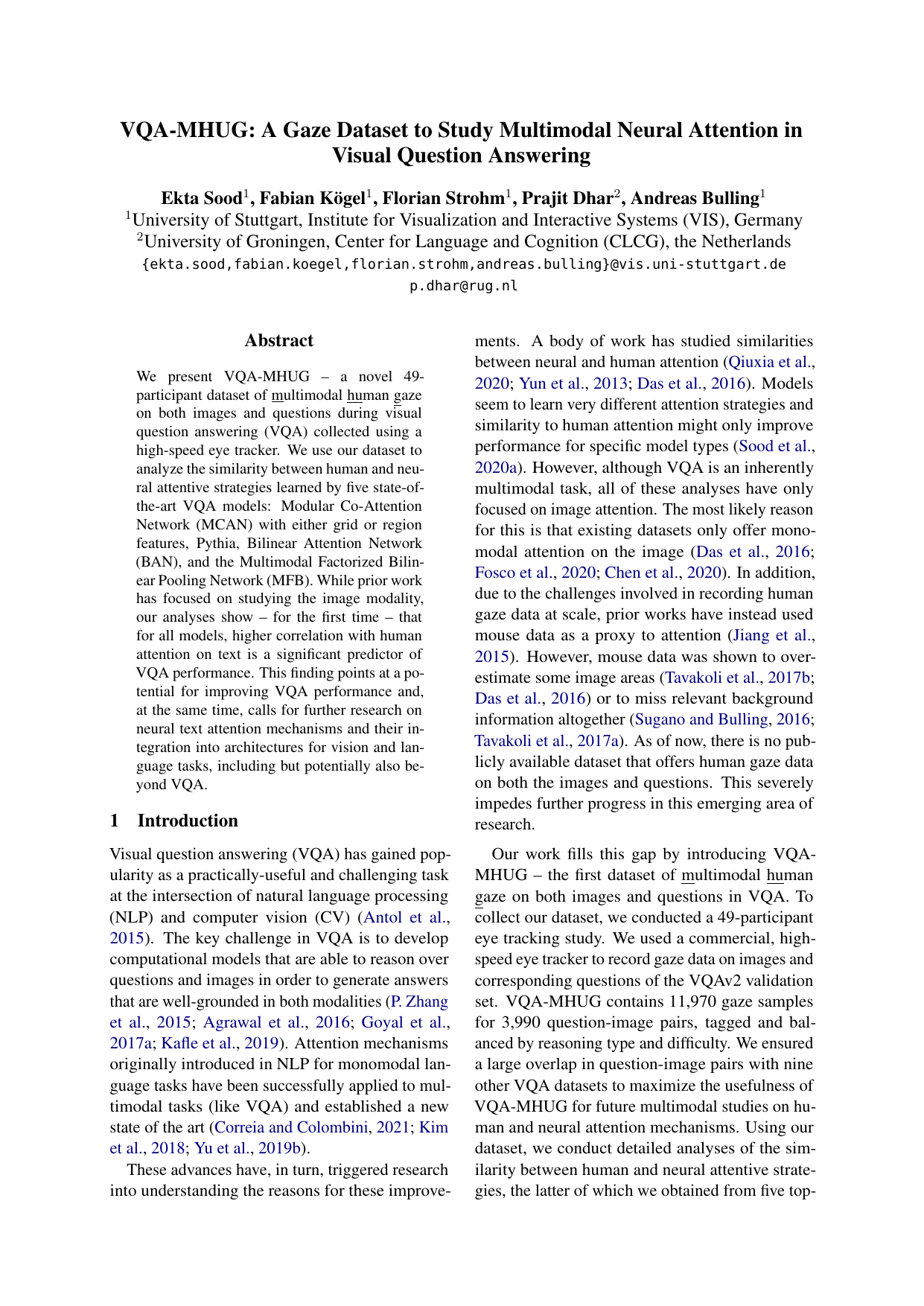
VQA-MHUG: A gaze dataset to study multimodal neural attention in VQA
Ekta Sood, Fabian Kögel, Florian Strohm, Prajit Dhar, Andreas Bulling
Proc. ACL SIGNLL Conference on Computational Natural Language Learning (CoNLL), pp. 27--43, 2021.
AbstractLinksBibTeXProject Oral Presentation
We present VQA-MHUG - a novel 49-participant dataset of multimodal human gaze on both images and questions during visual question answering (VQA) collected using a high-speed eye tracker. We use our dataset to analyze the similarity between human and neural attentive strategies learned by five state-of-the-art VQA models: Modulated Co-Attention Network (MCAN) with either grid or region features, Pythia, Bilinear Attention Network (BAN), and the Multimodal Factorized Bilinear Pooling Network (MFB). While prior work has focused on studying the image modality, our analyses show - for the first time - that for all models, higher correlation with human attention on text is a significant predictor of VQA performance. This finding points at a potential for improving VQA performance and, at the same time, calls for further research on neural text attention mechanisms and their integration into architectures for vision and language tasks, including but potentially also beyond VQA.
@inproceedings{sood21_conll,
title = {VQA-MHUG: A gaze dataset to study multimodal neural attention in VQA},
author = {Sood, Ekta and Kögel, Fabian and Strohm, Florian and Dhar, Prajit and Bulling, Andreas},
year = {2021},
booktitle = {Proc. ACL SIGNLL Conference on Computational Natural Language Learning (CoNLL)},
pages = {27--43},
doi = {10.18653/v1/2021.conll-1.3},
publisher = {Association for Computational Linguistics},
}