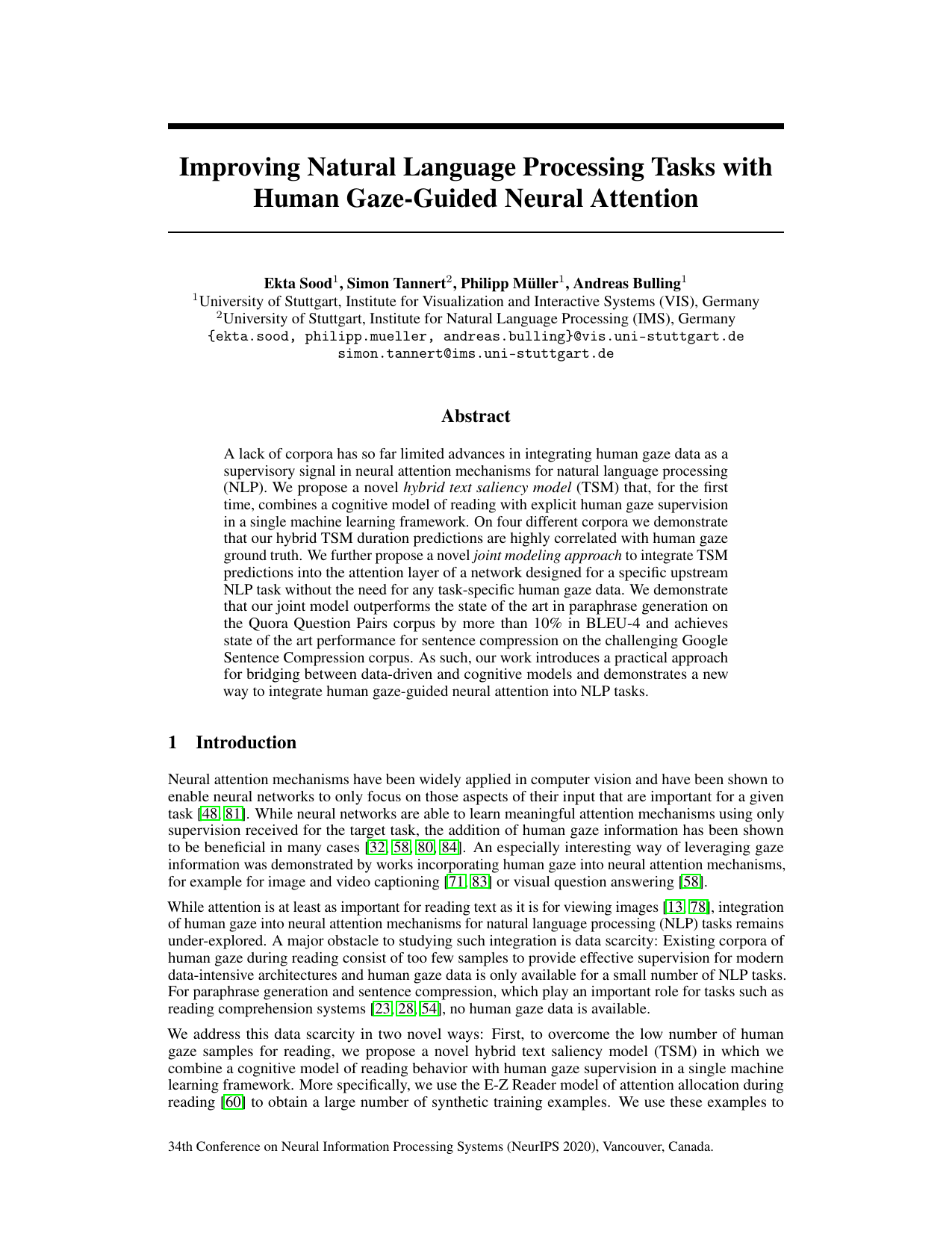
Improving Natural Language Processing Tasks with Human Gaze-Guided Neural Attention
Ekta Sood, Simon Tannert, Philipp Müller, Andreas Bulling
Advances in Neural Information Processing Systems (NeurIPS), pp. 1--15, 2020.
AbstractLinksBibTeXProject
A lack of corpora has so far limited advances in integrating human gaze data as a supervisory signal in neural attention mechanisms for natural language processing (NLP). We propose a novel hybrid text saliency model (TSM) that, for the first time, combines a cognitive model of reading with explicit human gaze supervision in a single machine learning framework. We show on four different corpora that our hybrid TSM duration predictions are highly correlated with human gaze ground truth. We further propose a novel joint modelling approach to integrate the predictions of the TSM into the attention layer of a network designed for a specific upstream task without the need for task-specific human gaze data. We demonstrate that our joint model outperforms the state of the art in paraphrase generation on the Quora Question Pairs corpus by more than 10% in BLEU-4 and achieves state-of-the-art performance for sentence compression on the challenging Google Sentence Compression corpus. As such, our work introduces a practical approach for bridging between data-driven and cognitive models and demonstrates a new way to integrate human gaze-guided neural attention into NLP tasks.
@inproceedings{sood20_neurips,
title = {Improving Natural Language Processing Tasks with Human Gaze-Guided Neural Attention},
author = {Sood, Ekta and Tannert, Simon and Müller, Philipp and Bulling, Andreas},
year = {2020},
booktitle = {Advances in Neural Information Processing Systems (NeurIPS)},
pages = {1--15},
url = {https://proceedings.neurips.cc/paper/2020/hash/460191c72f67e90150a093b4585e7eb4-Abstract.html},
}
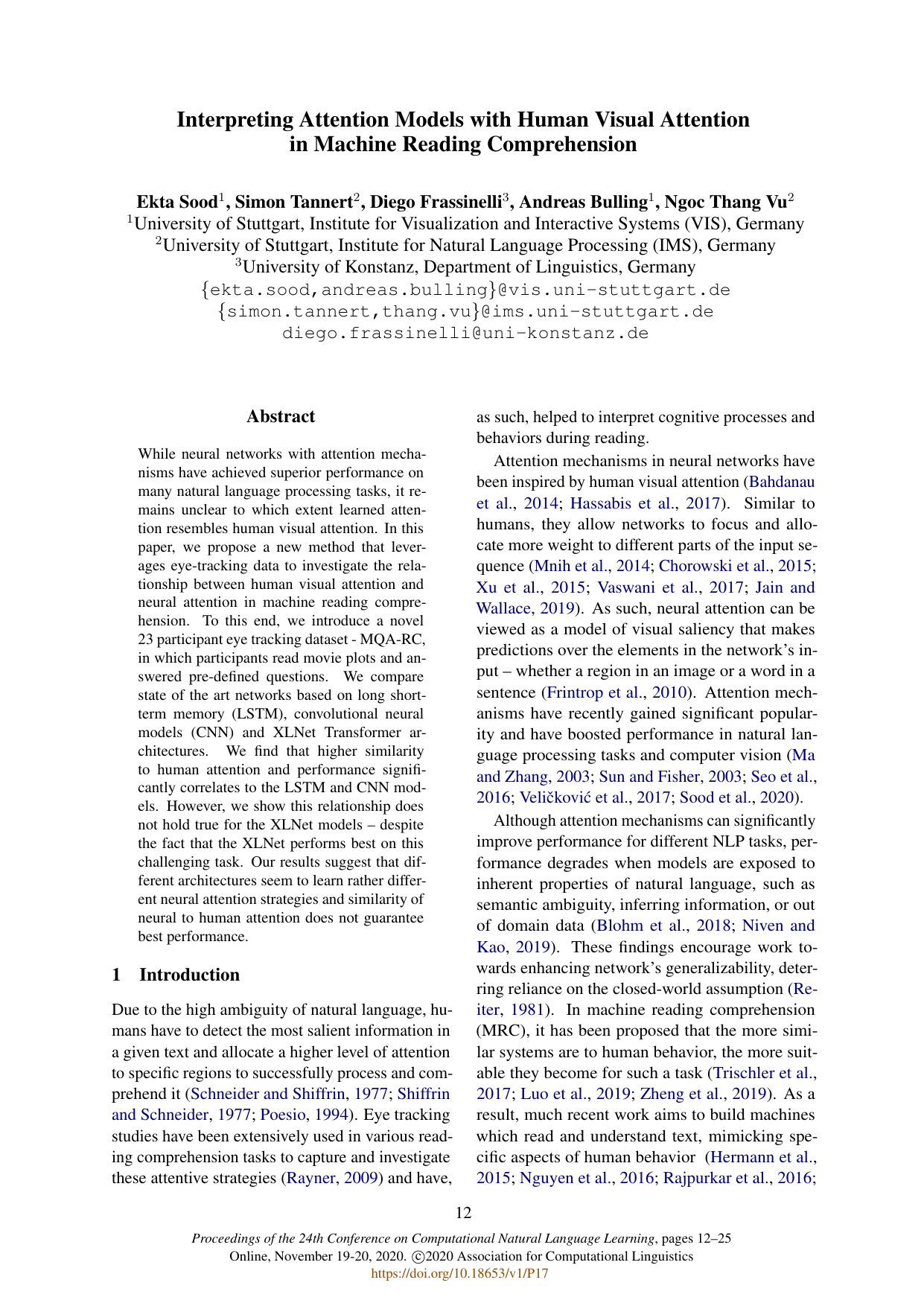
Interpreting Attention Models with Human Visual Attention in Machine Reading Comprehension
Ekta Sood, Simon Tannert, Diego Frassinelli, Andreas Bulling, Ngoc Thang Vu
Proc. ACL SIGNLL Conference on Computational Natural Language Learning (CoNLL), pp. 12-25, 2020.
AbstractLinksBibTeXProject
While neural networks with attention mechanisms have achieved superior performance on many natural language processing tasks, it remains unclear to which extent learned attention resembles human visual attention. In this paper, we propose a new method that leverages eye-tracking data to investigate the relationship between human visual attention and neural attention in machine reading comprehension. To this end, we introduce a novel 23 participant eye tracking dataset - MQA-RC, in which participants read movie plots and answered pre-defined questions. We compare state of the art networks based on long short-term memory (LSTM), convolutional neural models (CNN) and XLNet Transformer architectures. We find that higher similarity to human attention and performance significantly correlates to the LSTM and CNN models. However, we show this relationship does not hold true for the XLNet models – despite the fact that the XLNet performs best on this challenging task. Our results suggest that different architectures seem to learn rather different neural attention strategies and similarity of neural to human attention does not guarantee best performance.
@inproceedings{sood20_conll,
title = {Interpreting Attention Models with Human Visual Attention in Machine Reading Comprehension},
author = {Sood, Ekta and Tannert, Simon and Frassinelli, Diego and Bulling, Andreas and Vu, Ngoc Thang},
year = {2020},
booktitle = {Proc. ACL SIGNLL Conference on Computational Natural Language Learning (CoNLL)},
pages = {12-25},
doi = {10.18653/v1/P17},
publisher = {Association for Computational Linguistics},
}