Publications
2023
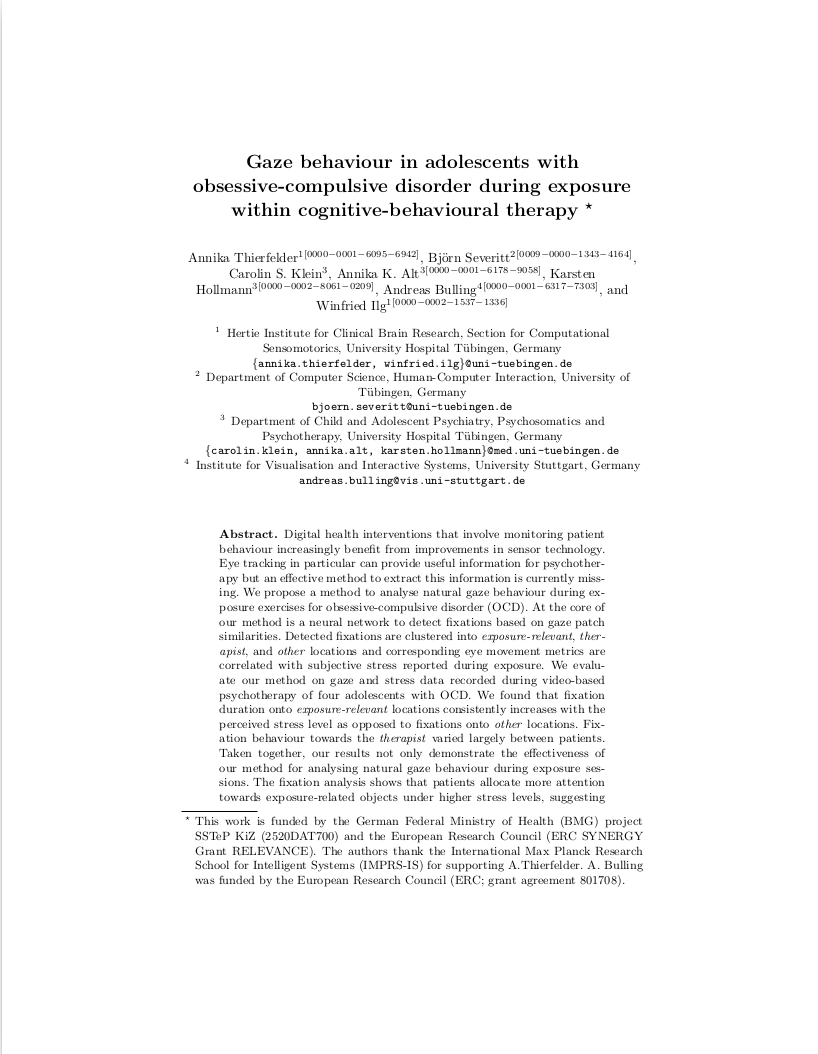
Gaze Behaviour in Adolescents with Obsessive-compulsive Disorder During Exposure Within Cognitive-behavioural Therapy
Annika Thierfelder, Björn Severitt, Carolin Sarah Klein, Annika Kristin Alt, Karsten Hollmann, Andreas Bulling, Winfried Ilg
Proc. 17th EAI International Conference on Pervasive Computing Technologies for Healthcare (Pervasive Health), 2023.
AbstractLinksBibTeXProject
Digital health interventions that involve monitoring patient behaviour increasingly benefit from improvements in sensor technology. Eye tracking in particular can provide useful information for psychotherapy but an effective method to extract this information is currently missing. We propose a method to analyse natural gaze behaviour during exposure exercises for obsessive-compulsive disorder (OCD). At the core of our method is a neural network to detect fixations based on gaze patch similarities. Detected fixations are clustered into exposure-relevant, therapist, and other locations and corresponding eye movement metrics are correlated with subjective stress reported during exposure. We evaluate our method on gaze and stress data recorded during video-based psychotherapy of four adolescents with OCD. We found that fixation duration onto exposure-relevant locations consistently increases with the perceived stress level as opposed to fixations onto other locations. Fixation behaviour towards the therapist varied largely between patients. Taken together, our results not only demonstrate the effectiveness of our method for analysing natural gaze behaviour during exposure sessions. The fixation analysis shows that patients allocate more attention towards exposure-related objects under higher stress levels, suggesting higher mental load. As such, providing feedback on fixation behaviour holds significant promise to support therapists in monitoring intensity of exposure exercises.
@inproceedings{thierfelder23_pervasiveh,
title = {Gaze Behaviour in Adolescents with Obsessive-compulsive Disorder During Exposure Within Cognitive-behavioural Therapy},
author = {Thierfelder, Annika and Severitt, Björn and Klein, Carolin Sarah and Alt, Annika Kristin and Hollmann, Karsten and Bulling, Andreas and Ilg, Winfried},
year = {2023},
booktitle = {Proc. 17th EAI International Conference on Pervasive Computing Technologies for Healthcare (Pervasive Health)},
doi = {10.13140/RG.2.2.30047.02721},
}
2022
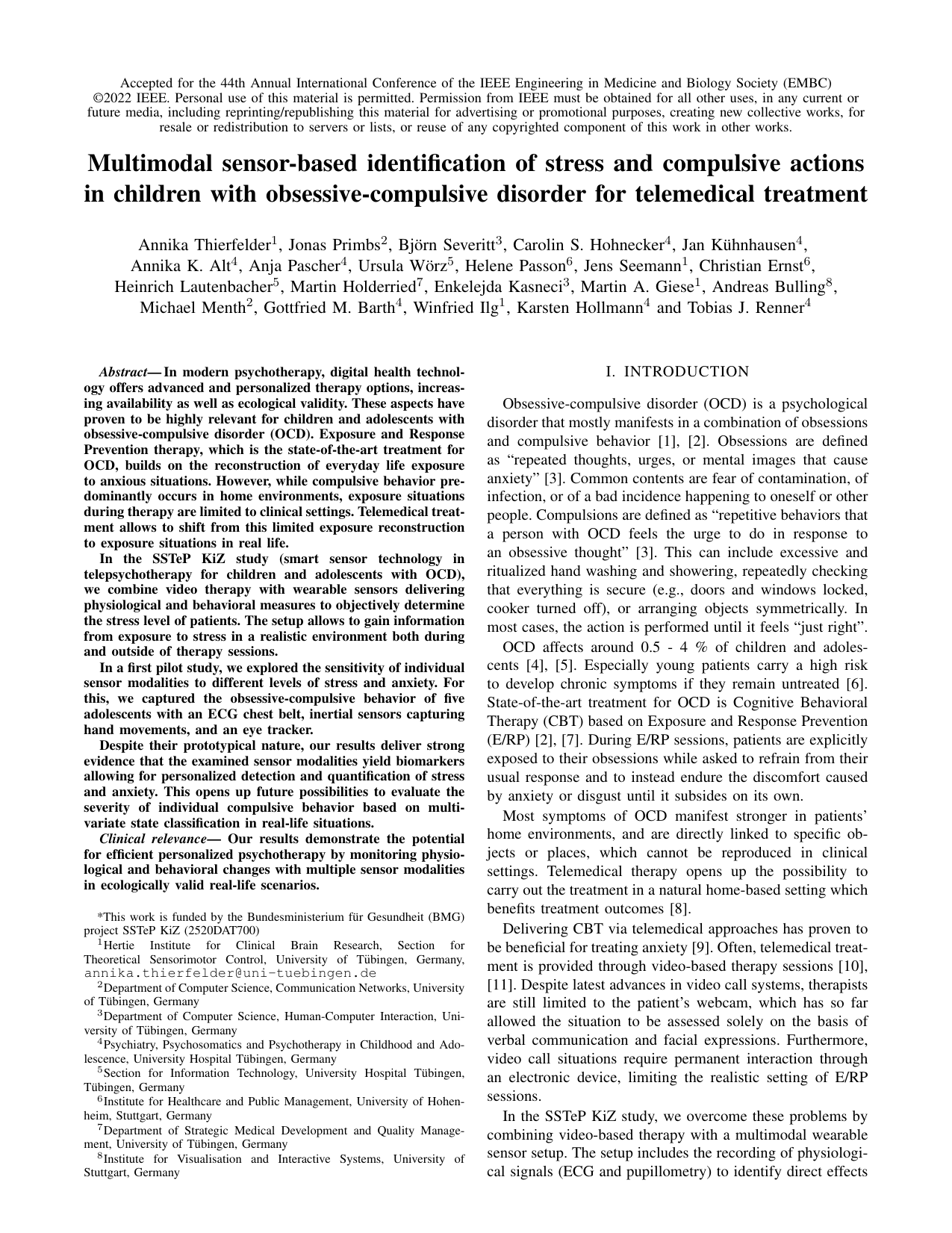
Multimodal Sensor-based Identification of Stress and Compulsive Actions in Children with Obsessive-compulsive Disorder for Telemedical Treatment
Annika Thierfelder, Jonas Primbs, Björn Severitt, Carolin Sarah Hohnecker, Jan Kühnhausen, Annika Kristin Alt, Anja Pascher, Ursula Wörz, Helene Passon, Jens Seemann, Christian Ernst, Heinrich Lautenbacher, Martin Holderried, Enkelejda Kasneci, Martin Giese, Andreas Bulling, Michael Menth, Gottfried Maria Barth, Winfried Ilg, Karsten Hollmann, Tobias Johann Renner
Proc. the 44th Annual International Conference of the IEEE Engineering in Medicine and Biology Society (EMBC), pp. 1--7, 2022.
AbstractLinksBibTeXProject
In modern psychotherapy, digital health technology offers advanced and personalized therapy options, increasing availability as well as ecological validity. These aspects have proven to be highly relevant for children and adolescents with obsessive-compulsive disorder (OCD). Exposure and Response Prevention therapy, which is the state-of-the-art treatment for OCD, builds on the reconstruction of everyday life exposure to anxious situations. However, while compulsive behavior predominantly occurs in home environments, exposure situations during therapy are limited to clinical settings. Telemedical treatment allows to shift from this limited exposure reconstruction to exposure situations in real life. In the SSTeP KiZ study (smart sensor technology in telepsychotherapy for children and adolescents with OCD), we combine video therapy with wearable sensors delivering physiological and behavioral measures to objectively determine the stress level of patients. The setup allows to gain information from exposure to stress in a realistic environment both during and outside of therapy sessions. In a first pilot study, we explored the sensitivity of individual sensor modalities to different levels of stress and anxiety. For this, we captured the obsessive-compulsive behavior of five adolescents with an ECG chest belt, inertial sensors capturing hand movements, and an eye tracker. Despite their prototypical nature, our results deliver strong evidence that the examined sensor modalities yield biomarkers allowing for personalized detection and quantification of stress and anxiety. This opens up future possibilities to evaluate the severity of individual compulsive behavior based on multivariate state classification in real-life situations.
@inproceedings{thierfelder22_embc,
title = {Multimodal Sensor-based Identification of Stress and Compulsive Actions in Children with Obsessive-compulsive Disorder for Telemedical Treatment},
author = {Annika Thierfelder and Jonas Primbs and Björn Severitt and Carolin Sarah Hohnecker and Jan Kühnhausen and Annika Kristin Alt and Anja Pascher and Ursula Wörz and Helene Passon and Jens Seemann and Christian Ernst and Heinrich Lautenbacher and Martin Holderried and Enkelejda Kasneci and Martin Giese and Andreas Bulling and Michael Menth and Gottfried Maria Barth and Winfried Ilg and Karsten Hollmann and Tobias Johann Renner},
year = {2022},
booktitle = {Proc. the 44th Annual International Conference of the IEEE Engineering in Medicine and Biology Society (EMBC)},
pages = {1--7},
doi = {10.1109/EMBC48229.2022.9871899},
}
2021
Turning movements in real life capture subtle longitudinal and preataxic changes in cerebellar ataxia
Annika Thierfelder, Jens Seemann, Natalie John, Martin Giese, Ludger Schöls, Dagmar Tinmann, Matthis Synofzik, Winfried Ilg
biorXiv:2021.03.22.436330, 2021.
AbstractLinksBibTeXProject
OBJECTIVES Clinical and regulatory acceptance of upcoming molecular treatments in degenerative ataxias might greatly benefit from ecologically valid endpoints which capture change in ataxia severity in patients\textquoteright real life. This longitudinal study aimed to unravel quantitative motor biomarkers in degenerative ataxias in real life turning movements which are sensitive for changes both longitudinally and at the preataxic stage.METHODS Combined cross-sectional (n=30) and longitudinal (n=14, 1-year interval) observational study in degenerative cerebellar disease (including 8 pre-ataxic mutation carriers) compared to 23 healthy controls. Turning movements were assessed by three body-worn inertial sensors in three conditions: (1) instructed laboratory assessment, (2) supervised free walking, and (3) unsupervised real-life movements.RESULTS Measures which quantified dynamic balance during turning \textendash lateral velocity change (LVC) and outward acceleration \textendash, but not general turning measures such as speed, allowed differentiating ataxic against healthy subjects in real life with high effect size (δ=0.68), with LVC also differentiating preataxic against healthy subjects (δ=0.53). LVC was highly correlated with clinical ataxia severity (SARA score, effect size ρ=0.79) and subjective balance confidence (ABC score, ρ=0.66). Moreover, LVC in real life \textendash but not general turning measures, gait measures, or the SARA score \textendash allowed detecting significant longitudinal change in one-year follow-up with high effect size (rprb=0.66).CONCLUSIONS Measures of turning allow to capture specific changes of dynamic balance in degenerative ataxia in real life, with high sensitivity to longitudinal differences in ataxia severity and to the preataxic stage. They thus present promising ecologically valid motor biomarkers for capturing change in real life, even in the highly treatment-relevant early stages of degenerative cerebellar disease.
@techreport{thierfelder21_biorxiv,
title = {Turning movements in real life capture subtle longitudinal and preataxic changes in cerebellar ataxia},
author = {Thierfelder, Annika and Seemann, Jens and John, Natalie and Giese, Martin and Schöls, Ludger and Tinmann, Dagmar and Synofzik, Matthis and Ilg, Winfried},
year = {2021},
doi = {10.1101/2021.03.22.436330},
}
Fooling the size–weight illusion—Using augmented reality to eliminate the effect of size on perceptions of heaviness and sensorimotor prediction
Nina Rohrbach, Joachim Hermsdörfer, Lisa-Marie Huber, Annika Thierfelder, Gavin Buckingham
Virtual Reality, pp. 1-10, 2021.
AbstractLinksBibTeXProject
Augmented reality, whereby computer-generated images are overlaid onto the physical environment, is becoming significant part of the world of education and training. Little is known, however, about how these external images are treated by the sensorimotor system of the user – are they fully integrated into the external environmental cues, or largely ignored by low-level perceptual and motor processes? Here, we examined this question in the context of the size–weight illusion (SWI). Thirty-two participants repeatedly lifted and reported the heaviness of two cubes of unequal volume but equal mass in alternation. Half of the participants saw semi-transparent equally sized holographic cubes superimposed onto the physical cubes through a head-mounted display. Fingertip force rates were measured prior to lift-off to determine how the holograms influenced sensorimotor prediction, while verbal reports of heaviness after each lift indicated how the holographic size cues influenced the SWI. As expected, participants who lifted without augmented visual cues lifted the large object at a higher rate of force than the small object on early lifts and experienced a robust SWI across all trials. In contrast, participants who lifted the (apparently equal-sized) augmented cubes used similar force rates for each object. Furthermore, they experienced no SWI during the first lifts of the objects, with a SWI developing over repeated trials. These results indicate that holographic cues initially dominate physical cues and cognitive knowledge, but are dismissed when conflicting with cues from other senses.
@article{rohrbach2021_vr,
title = {Fooling the size–weight illusion—Using augmented reality to eliminate the effect of size on perceptions of heaviness and sensorimotor prediction},
author = {Rohrbach, Nina and Hermsdörfer, Joachim and Huber, Lisa-Marie and Thierfelder, Annika and Buckingham, Gavin},
year = {2021},
journal = {Virtual Reality},
pages = {1-10},
doi = {10.1007/s10055-021-00508-3},
}