Publications
2026

UP-FacE: User-predictable Fine-grained Face Shape Editing
Florian Strohm, Mihai Bâce, Andreas Bulling
Proc. IEEE Conference on Computer Vision and Pattern Recognition Workshops (CVPRW), 2026.
AbstractLinksBibTeXProject
We present User-predictable Face Editing (UP-FacE) - a novel method for predictable face shape editing. In stark contrast to existing methods for face editing using trial and error, edits with UP-FacE are predictable by the human user. That is, users can control the desired degree of change precisely and deterministically and know upfront the amount of change required to achieve a certain editing result. Our method leverages facial landmarks to precisely measure facial feature values, facilitating the training of UP-FacE without manually annotated attribute labels. At the core of UP-FacE is a transformer-based network that takes as input a latent vector from a pre-trained generative model and a facial feature embedding, and predicts a suitable manipulation vector. To enable user-predictable editing, a scaling layer adjusts the manipulation vector to achieve the precise desired degree of change. To ensure that the desired feature is manipulated towards the target value without altering uncorrelated features, we further introduce a novel semantic face feature loss. Additionally, we analyse the correlations between different facial features and incorporate this information into the transformer network's regularization process. This dynamic regularization allows naturally correlated facial features to be adjusted simultaneously in a coherent manner. Qualitative and quantitative results demonstrate that UP-FacE provides competitive face editing capabilities while offering precise and user-predictable control over 23 distinct facial shape features.
@inproceedings{strohm26_cvprw,
title = {{UP-FacE}: User-predictable Fine-grained Face Shape Editing},
author = {Strohm, Florian and B{\^a}ce, Mihai and Bulling, Andreas},
year = {2026},
booktitle = {Proc. IEEE Conference on Computer Vision and Pattern Recognition Workshops (CVPRW)},
}
2025

HAIFAI: Human-AI Interaction for Mental Face Reconstruction
Florian Strohm, Mihai Bâce, Andreas Bulling
ACM Transactions on Interactive Intelligent Systems (TiiS), 15 (2), pp. 1--26, 2025.
AbstractLinksBibTeXProject
We present HAIFAI - a novel two-stage system where humans and AI interact to tackle the challenging task of reconstructing a visual representation of a face that exists only in a person’s mind. In the first stage, users iteratively rank images our reconstruction system presents based on their resemblance to a mental image. These rankings, in turn, allow the system to extract relevant image features, fuse them into a unified feature vector, and use a generative model to produce an initial reconstruction of the mental image. The second stage leverages an existing face editing method, allowing users to manually refine and further improve this reconstruction using an easy-to-use slider interface for face shape manipulation. To avoid the need for tedious human data collection for training the reconstruction system, we introduce a computational user model of human ranking behaviour. For this, we collected a small face ranking dataset through an online crowd-sourcing study containing data from 275 participants. We evaluate HAIFAI and an ablated version in a 12-participant user study and demonstrate that our approach outperforms the previous state of the art regarding reconstruction quality, usability, perceived workload, and reconstruction speed. We further validate the reconstructions in a subsequent face ranking study with 18 participants and show that HAIFAI achieves a new state-of-the-art identification rate of 60.6%. These findings represent a significant advancement towards developing new interactive intelligent systems capable of reliably and effortlessly reconstructing a user's mental image.
@article{strohm25_tiis,
title = {{HAIFAI}: {Human}-{AI} {Interaction} for {Mental} {Face} {Reconstruction}},
author = {Strohm, Florian and Bâce, Mihai and Bulling, Andreas},
year = {2025},
journal = {ACM Transactions on Interactive Intelligent Systems (TiiS)},
volume = {15},
number = {2},
pages = {1--26},
doi = {10.1145/3725891},
}
2024

Individual differences in visuo-spatial working memory capacity and prior knowledge during interrupted reading
Francesca Zermiani, Prajit Dhar, Florian Strohm, Sibylle Baumbach, Andreas Bulling, Maria Wirzberger
Frontiers in Cognition, 3, pp. 1--9, 2024.
AbstractLinksBibTeXProject
Interruptions are often pervasive and require attentional shifts from the primary task. Limited data are available on the factors influencing individuals' efficiency in resuming from interruptions during digital reading. The reported investigation -conducted using the InteRead dataset -examined whether individual differences in visuo-spatial working memory capacity (vsWMC) and prior knowledge could influence resumption lag times during interrupted reading. Participants' vsWMC capacity was assessed using the symmetry span (SSPAN) task, while a pre-test questionnaire targeted their background knowledge about the text. While reading an extract from a Sherlock Holmes story, they were interrupted six times and asked to answer an opinion question. Our analyses revealed that the interaction between vsWMC and prior knowledge significantly predicted the time needed to resume reading following an interruption. The results from our analyses are discussed in relation to theoretical frameworks of task resumption and current research in the field.
@article{zermiani24_fic,
title = {Individual differences in visuo-spatial working memory capacity and prior knowledge during interrupted reading},
author = {Zermiani, Francesca and Dhar, Prajit and Strohm, Florian and Baumbach, Sibylle and Bulling, Andreas and Wirzberger, Maria},
year = {2024},
journal = {Frontiers in Cognition},
volume = {3},
pages = {1--9},
doi = {10.3389/fcogn.2024.1434642},
}
Learning User Embeddings from Human Gaze for Personalised Saliency Prediction
Florian Strohm, Mihai Bâce, Andreas Bulling
Proc. ACM on Human-Computer Interaction (PACM HCI), 8 (ETRA), pp. 1--18, 2024.
AbstractLinksBibTeXProject
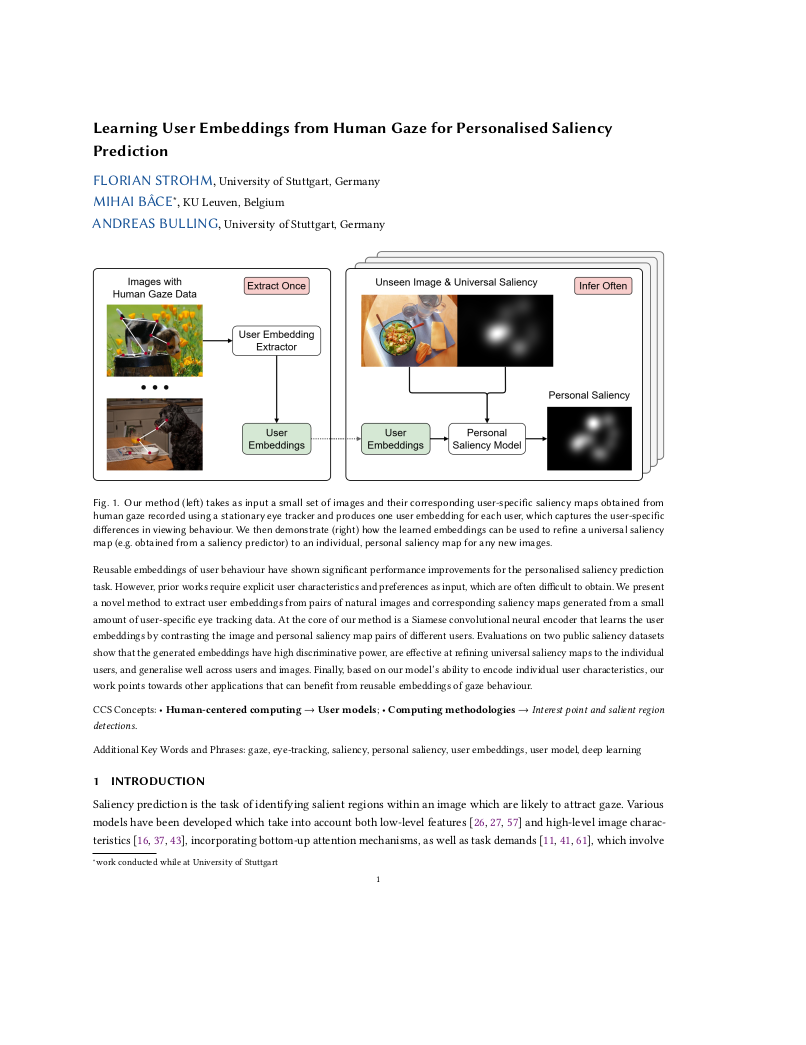
Reusable embeddings of user behaviour have shown significant performance improvements for the personalised saliency prediction task. However, prior works require explicit user characteristics and preferences as input, which are often difficult to obtain. We present a novel method to extract user embeddings from pairs of natural images and corresponding saliency maps generated from a small amount of user-specific eye tracking data. At the core of our method is a Siamese convolutional neural encoder that learns the user embeddings by contrasting the image and personal saliency map pairs of different users. Evaluations on two saliency datasets show that the generated embeddings have high discriminative power, are effective at refining universal saliency maps to the individual users, and generalise well across users and images. Finally, based on our model's ability to encode individual user characteristics, our work points towards other applications that can benefit from reusable embeddings of gaze behaviour.
@article{strohm24_etra,
title = {Learning User Embeddings from Human Gaze for Personalised Saliency Prediction},
author = {Florian Strohm and Mihai Bâce and Andreas Bulling},
year = {2024},
journal = {Proc. ACM on Human-Computer Interaction (PACM HCI)},
volume = {8},
number = {ETRA},
pages = {1--18},
doi = {10.1145/3655603},
}

SeFFeC: Semantic Facial Feature Control for Fine-grained Face Editing
Florian Strohm, Mihai Bâce, Markus Kaltenecker, Andreas Bulling
arXiv:2403.13972, pp. 1--18, 2024.
AbstractLinksBibTeXProject
We propose Semantic Facial Feature Control (SeFFeC) - a novel method for fine-grained face shape editing. Our method enables the manipulation of human-understandable, semantic face features, such as nose length or mouth width, which are defined by different groups of facial landmarks. In contrast to existing methods, the use of facial landmarks enables precise measurement of the facial features, which then enables training SeFFeC without any manually annotated labels. SeFFeC consists of a transformer-based encoder network that takes a latent vector of a pre-trained generative model and a facial feature embedding as input, and learns to modify the latent vector to perform the desired face edit operation. To ensure that the desired feature measurement is changed towards the target value without altering uncorrelated features, we introduced a novel semantic face feature loss. Qualitative and quantitative results show that SeFFeC enables precise and fine-grained control of 23 facial features, some of which could not previously be controlled by other methods, without requiring manual annotations. Unlike existing methods, SeFFeC also provides deterministic control over the exact values of the facial features and more localised and disentangled face edits.
@techreport{strohm24_arxiv_2,
title = {SeFFeC: Semantic Facial Feature Control for Fine-grained Face Editing},
author = {Florian Strohm and Mihai Bâce and Markus Kaltenecker and Andreas Bulling},
year = {2024},
pages = {1--18},
url = {https://arxiv.org/abs/2403.13972},
}
2023

Usable and Fast Interactive Mental Face Reconstruction
Florian Strohm, Mihai Bâce, Andreas Bulling
Proc. ACM Symposium on User Interface Software and Technology (UIST), pp. 1--15, 2023.
AbstractLinksBibTeXProject
We introduce an end-to-end interactive system for mental face reconstruction – the challenging task of visually reconstructing a face image a person only has in their mind. In contrast to existing
methods that suffer from low usability and high mental load, our approach only requires the user to rank images over multiple iterations according to the perceived similarity with their mental image.
Based on these rankings, our mental face reconstruction system extracts image features in each iteration, combines them into a joint feature vector, and then uses a generative model to visually reconstruct the mental image. To avoid the need for collecting large
amounts of human training data, we further propose a computational user model that can simulate human ranking behaviour using data from an online crowd-sourcing study (N=215). Results from a 12-participant user study show that our method can reconstruct mental images that are visually similar to existing approaches but has significantly higher usability, lower perceived workload, and
is 40% faster. In addition, results from a third 22-participant lineup study in which we validated our reconstructions on a face ranking task show a identification rate of 55.3%, which is in line with prior work. These results represent an important step towards new interactive intelligent systems that can robustly and effortlessly reconstruct a user’s mental image.
@inproceedings{strohm23_uist,
title = {Usable and Fast Interactive Mental Face Reconstruction},
author = {Strohm, Florian and B{\^a}ce, Mihai and Bulling, Andreas},
year = {2023},
booktitle = {Proc. ACM Symposium on User Interface Software and Technology (UIST)},
pages = {1--15},
doi = {https://doi.org/10.1145/3586183.3606795},
}

Int-HRL: Towards Intention-based Hierarchical Reinforcement Learning
Anna Penzkofer, Simon Schaefer, Florian Strohm, Mihai Bâce, Stefan Leutenegger, Andreas Bulling
Proc. Adaptive and Learning Agents Workshop (ALA), pp. 1--7, 2023.
AbstractLinksBibTeXProject
While deep reinforcement learning (RL) agents outperform humans on an increasing number of tasks, training them requires data equivalent to decades of human gameplay. Recent hierarchical RL methods have increased sample efficiency by incorporating information inherent to the structure of the decision problem but at the cost of having to discover or use human-annotated sub-goals that guide the learning process. We show that intentions of human players, i.e. the precursor of goal-oriented decisions, can be robustly predicted from eye gaze even for the long-horizon sparse rewards task of Montezuma’s Revenge – one of the most challenging RL tasks in the Atari2600 game suite. We propose Int-HRL: Hierarchical RL with intention-based sub-goals that are inferred from human eye gaze. Our novel sub-goal extraction pipeline is fully automatic and replaces the need for manual sub-goal annotation by human experts. Our evaluations show that replacing hand-crafted sub-goals with automatically extracted intentions leads to a HRL agent that is significantly more sample efficient than previous methods.
@inproceedings{penzkofer23_ala,
title = {Int-HRL: Towards Intention-based Hierarchical Reinforcement Learning},
author = {Anna Penzkofer and Simon Schaefer and Florian Strohm and Mihai Bâce and Stefan Leutenegger and Andreas Bulling},
year = {2023},
booktitle = {Proc. Adaptive and Learning Agents Workshop (ALA)},
pages = {1--7},
}

Facial Composite Generation with Iterative Human Feedback
Florian Strohm, Ekta Sood, Dominike Thomas, Mihai Bâce, Andreas Bulling
Proc. The 1st Gaze Meets ML workshop, PMLR, pp. 165--183, 2023.
AbstractLinksBibTeXProject
We propose the first method in which human and AI collaborate to iteratively reconstruct the human’s mental image of another person’s face only from their eye gaze. Current tools for generating digital human faces involve a tedious and time-consuming manual design process. While gaze-based mental image reconstruction represents a promising alternative, previous methods still assumed prior knowledge about the target face, thereby severely limiting their practical usefulness. The key novelty of our method is a collaborative, it- erative query engine: Based on the user’s gaze behaviour in each iteration, our method predicts which images to show to the user in the next iteration. Results from two human studies (N=12 and N=22) show that our method can visually reconstruct digital faces that are more similar to the mental image, and is more usable compared to other methods. As such, our findings point at the significant potential of human-AI collaboration for recon- structing mental images, potentially also beyond faces, and of human gaze as a rich source of information and a powerful mediator in said collaboration.
@inproceedings{strohm23_gmml,
title = {Facial Composite Generation with Iterative Human Feedback},
author = {Strohm, Florian and Sood, Ekta and Thomas, Dominike and B{\^a}ce, Mihai and Bulling, Andreas},
editor = {Lourentzou, Ismini and Wu, Joy and Kashyap, Satyananda and Karargyris, Alexandros and Celi, Leo Anthony and Kawas, Ban and Talathi, Sachin},
year = {2023},
booktitle = {Proc. The 1st Gaze Meets ML workshop, PMLR},
volume = {210},
pages = {165--183},
url = {https://proceedings.mlr.press/v210/strohm23a.html},
publisher = {PMLR},
series = {Proceedings of Machine Learning Research},
pdf = {https://proceedings.mlr.press/v210/strohm23a/strohm23a.pdf},
}
2021

Neural Photofit: Gaze-based Mental Image Reconstruction
Florian Strohm, Ekta Sood, Sven Mayer, Philipp Müller, Mihai Bâce, Andreas Bulling
Proc. IEEE International Conference on Computer Vision (ICCV), pp. 245-254, 2021.
AbstractLinksBibTeXProject
We propose a novel method that leverages human fixations to visually decode the image a person has in mind into a photofit (facial composite). Our method combines three neural networks: An encoder, a scoring network, and a decoder. The encoder extracts image features and predicts a neural activation map for each face looked at by a human observer. A neural scoring network compares the human and neural attention and predicts a relevance score for each extracted image feature. Finally, image features are aggregated into a single feature vector as a linear combination of all features weighted by relevance which a decoder decodes into the final photofit. We train the neural scoring network on a novel dataset containing gaze data of 19 participants looking at collages of synthetic faces. We show that our method significantly outperforms a mean baseline predictor and report on a human study that shows that we can decode photofits that are visually plausible and close to the observer's mental image. Code and dataset available upon request.
Code: Available upon request.
Dataset: Available upon request.
@inproceedings{strohm21_iccv,
title = {Neural Photofit: Gaze-based Mental Image Reconstruction},
author = {Florian Strohm and Ekta Sood and Sven Mayer and Philipp Müller and Mihai Bâce and Andreas Bulling},
year = {2021},
booktitle = {Proc. IEEE International Conference on Computer Vision (ICCV)},
pages = {245-254},
doi = {10.1109/ICCV48922.2021.00031},
}
VQA-MHUG: A gaze dataset to study multimodal neural attention in VQA
Ekta Sood, Fabian Kögel, Florian Strohm, Prajit Dhar, Andreas Bulling
Proc. ACL SIGNLL Conference on Computational Natural Language Learning (CoNLL), pp. 27--43, 2021.
AbstractLinksBibTeXProject Oral Presentation
We present VQA-MHUG - a novel 49-participant dataset of multimodal human gaze on both images and questions during visual question answering (VQA) collected using a high-speed eye tracker. We use our dataset to analyze the similarity between human and neural attentive strategies learned by five state-of-the-art VQA models: Modulated Co-Attention Network (MCAN) with either grid or region features, Pythia, Bilinear Attention Network (BAN), and the Multimodal Factorized Bilinear Pooling Network (MFB). While prior work has focused on studying the image modality, our analyses show - for the first time - that for all models, higher correlation with human attention on text is a significant predictor of VQA performance. This finding points at a potential for improving VQA performance and, at the same time, calls for further research on neural text attention mechanisms and their integration into architectures for vision and language tasks, including but potentially also beyond VQA.
@inproceedings{sood21_conll,
title = {VQA-MHUG: A gaze dataset to study multimodal neural attention in VQA},
author = {Sood, Ekta and Kögel, Fabian and Strohm, Florian and Dhar, Prajit and Bulling, Andreas},
year = {2021},
booktitle = {Proc. ACL SIGNLL Conference on Computational Natural Language Learning (CoNLL)},
pages = {27--43},
doi = {10.18653/v1/2021.conll-1.3},
publisher = {Association for Computational Linguistics},
}
2018

An Empirical Analysis of the Role of Amplifiers, Downtoners, and Negations in Emotion Classification in Microblogs
Florian Strohm, Roman Klinger
IEEE 5th International Conference on Data Science and Advanced Analytics (DSAA), pp. 673-681, 2018.
AbstractLinksBibTeXProject
The effect of amplifiers, downtoners, and negations has been studied in general and particularly in the context of sentiment analysis. However, there is only limited work which aims at transferring the results and methods to discrete classes of emotions, e.g., joy, anger, fear, sadness, surprise, and disgust. For instance, it is not straight-forward to interpret which emotion the phrase "not happy" expresses. With this paper, we aim at obtaining a better understanding of such modifiers in the context of emotion-bearing words and their impact on document-level emotion classification, namely, microposts on Twitter. We select an appropriate scope detection method for modifiers of emotion words, incorporate it in a document-level emotion classification model as additional bag of words and show that this approach improves the performance of emotion classification. In addition, we build a term weighting approach based on the different modifiers into a lexical model for the analysis of the semantics of modifiers and their impact on emotion meaning. We show that amplifiers separate emotions expressed with an emotion-bearing word more clearly from other secondary connotations. Downtoners have the opposite effect. In addition, we discuss the meaning of negations of emotion-bearing words. For instance we show empirically that "not happy" is closer to sadness than to anger and that fear words in the scope of downtoners often express surprise.
@inproceedings{strohm18_dsaa,
title = {An Empirical Analysis of the Role of Amplifiers, Downtoners, and Negations in Emotion Classification in Microblogs},
author = {Florian Strohm and Roman Klinger},
year = {2018},
booktitle = {IEEE 5th International Conference on Data Science and Advanced Analytics (DSAA)},
pages = {673-681},
doi = {10.1109/DSAA.2018.00087},
}


