Publications
2022
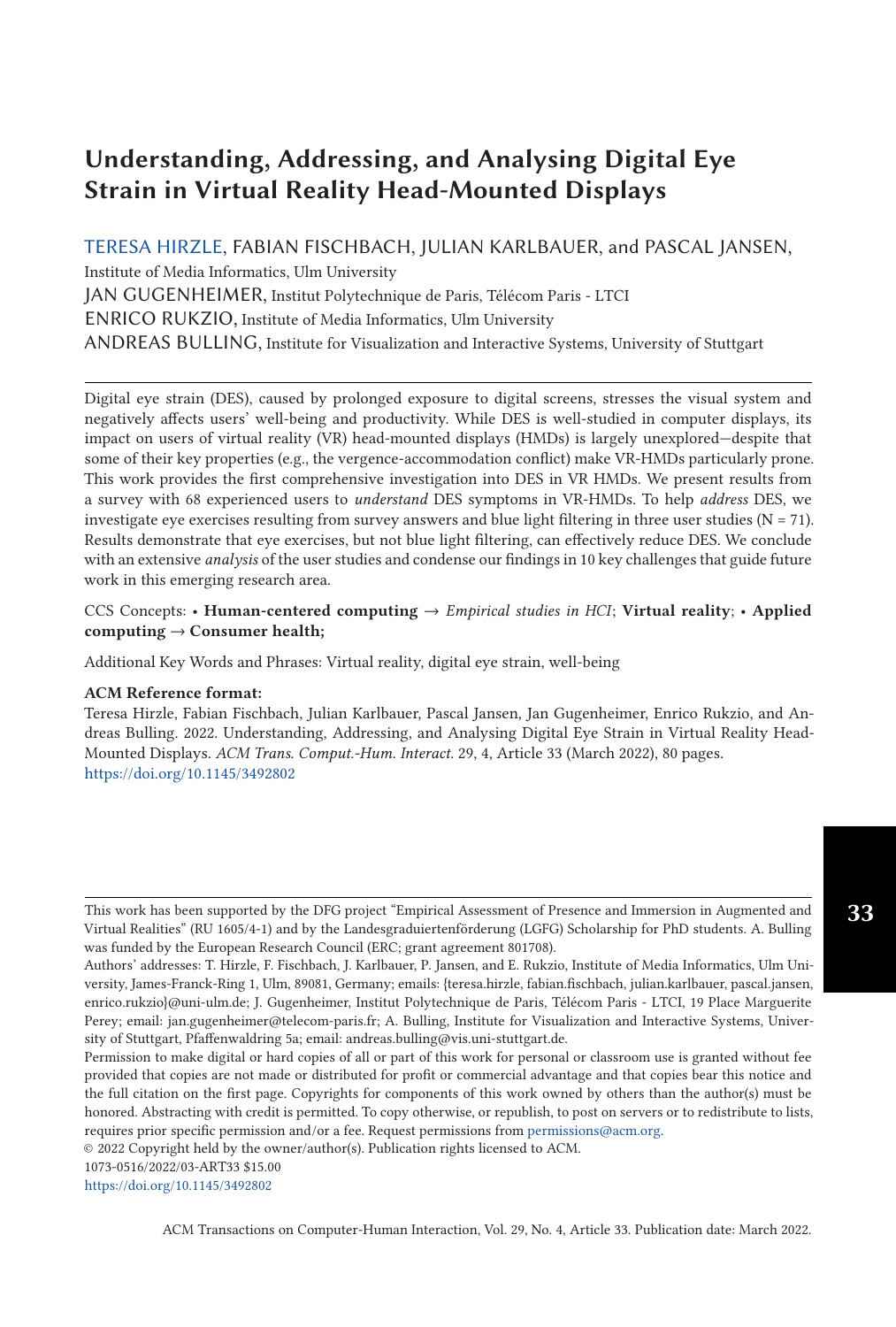
Understanding, Addressing, and Analysing Digital Eye Strain in Virtual Reality Head-Mounted Displays
Teresa Hirzle, Fabian Fischbach, Julian Karlbauer, Pascal Jansen, Jan Gugenheimer, Enrico Rukzio, Andreas Bulling
ACM Transactions on Computer-Human Interaction (TOCHI), 29 (4), pp. 1-80, 2022.
AbstractLinksBibTeXProject
Digital eye strain (DES), caused by prolonged exposure to digital screens, stresses the visual system and negatively affects users’ well-being and productivity. While DES is well-studied in computer displays, its impact on users of virtual reality (VR) head-mounted displays (HMDs) is largely unexplored—despite that some of their key properties (e.g., the vergence-accommodation conflict) make VR-HMDs particularly prone. This work provides the first comprehensive investigation into DES in VR HMDs. We present results from a survey with 68 experienced users to understand DES symptoms in VR-HMDs. To help address DES, we investigate eye exercises resulting from survey answers and blue light filtering in three user studies (N = 71). Results demonstrate that eye exercises, but not blue light filtering, can effectively reduce DES. We conclude with an extensive analysis of the user studies and condense our findings in 10 key challenges that guide future work in this emerging research area.
@article{hirzle22_tochi,
title = {Understanding, Addressing, and Analysing Digital Eye Strain in Virtual Reality Head-Mounted Displays},
author = {Teresa Hirzle and Fabian Fischbach and Julian Karlbauer and Pascal Jansen and Jan Gugenheimer and Enrico Rukzio and Andreas Bulling},
year = {2022},
journal = {ACM Transactions on Computer-Human Interaction (TOCHI)},
volume = {29},
number = {4},
pages = {1-80},
doi = {10.1145/3492802},
}
2021
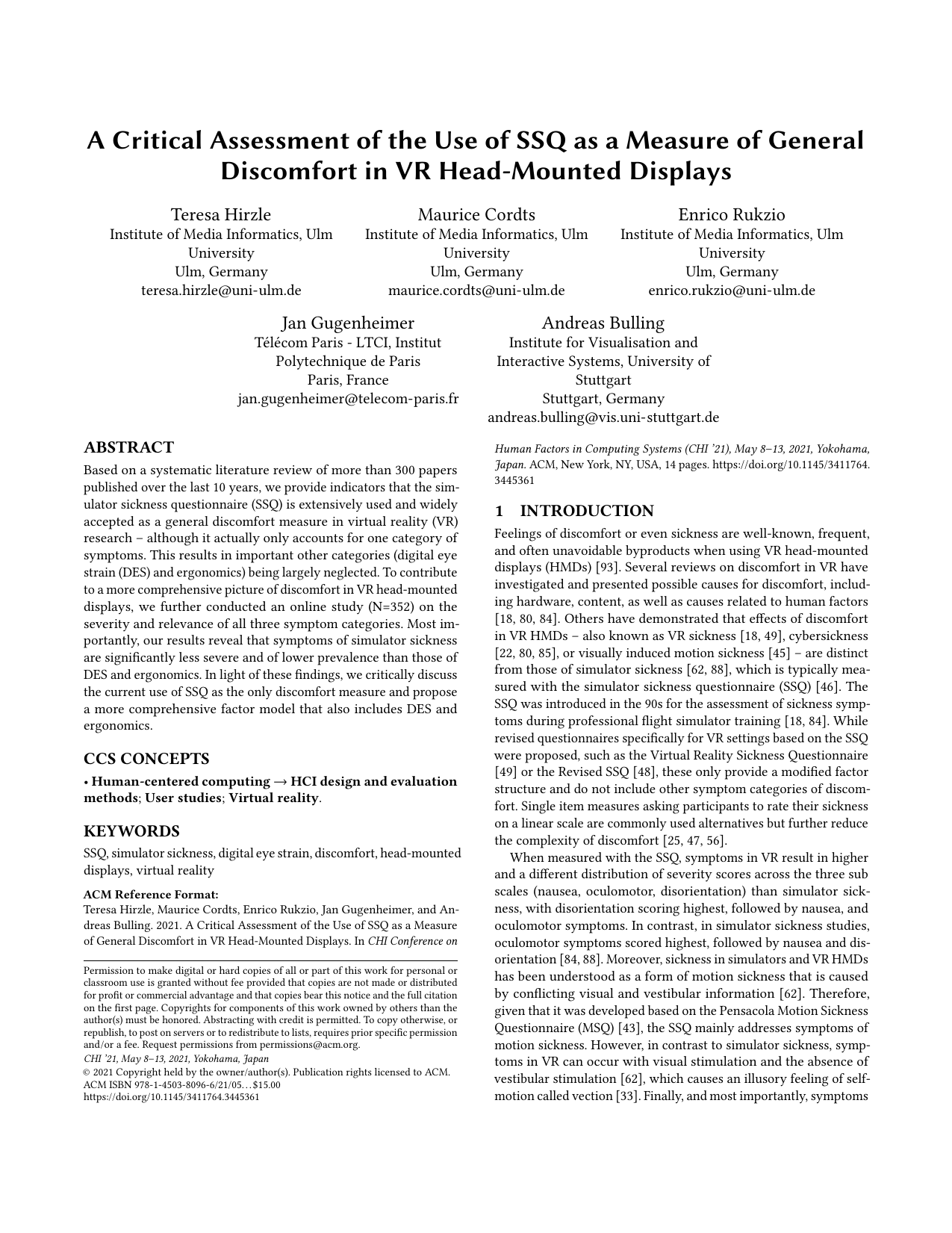
A Critical Assessment of the Use of SSQ as a Measure of General Discomfort in VR Head-Mounted Displays
Teresa Hirzle, Maurice Cordts, Enrico Rukzio, Jan Gugenheimer, Andreas Bulling
Proc. ACM SIGCHI Conference on Human Factors in Computing Systems (CHI), pp. 1--14, 2021.
AbstractLinksBibTeXProject
Based on a systematic literature review of more than 300 papers published over the last 10 years, we show that the simulator sickness questionnaire (SSQ) is extensively used and widely accepted as general discomfort measure in virtual reality (VR) research - although it only accounts for one category of symptoms. This results in important other categories (digital eye strain (DES) and ergonomics) being largely neglected. To contribute to a more comprehensive picture of discomfort in VR head-mounted displays, we further conducted an online study (N=352) on the severity and relevance of all three symptom categories. Most importantly, our results reveal that symptoms of simulator sickness are significantly less severe and of lower prevalence than those of DES and ergonomics. In light of these findings, we critically discuss the current use of SSQ as the only discomfort measure and propose a more comprehensive factor model that also includes DES and ergonomics.
@inproceedings{hirzle21_chi,
title = {A Critical Assessment of the Use of {SSQ} as a Measure of General Discomfort in VR Head-Mounted Displays},
author = {Teresa Hirzle and Maurice Cordts and Enrico Rukzio and Jan Gugenheimer and Andreas Bulling},
year = {2021},
booktitle = {Proc. ACM SIGCHI Conference on Human Factors in Computing Systems (CHI)},
pages = {1--14},
doi = {10.1145/3411764.3445361},
}
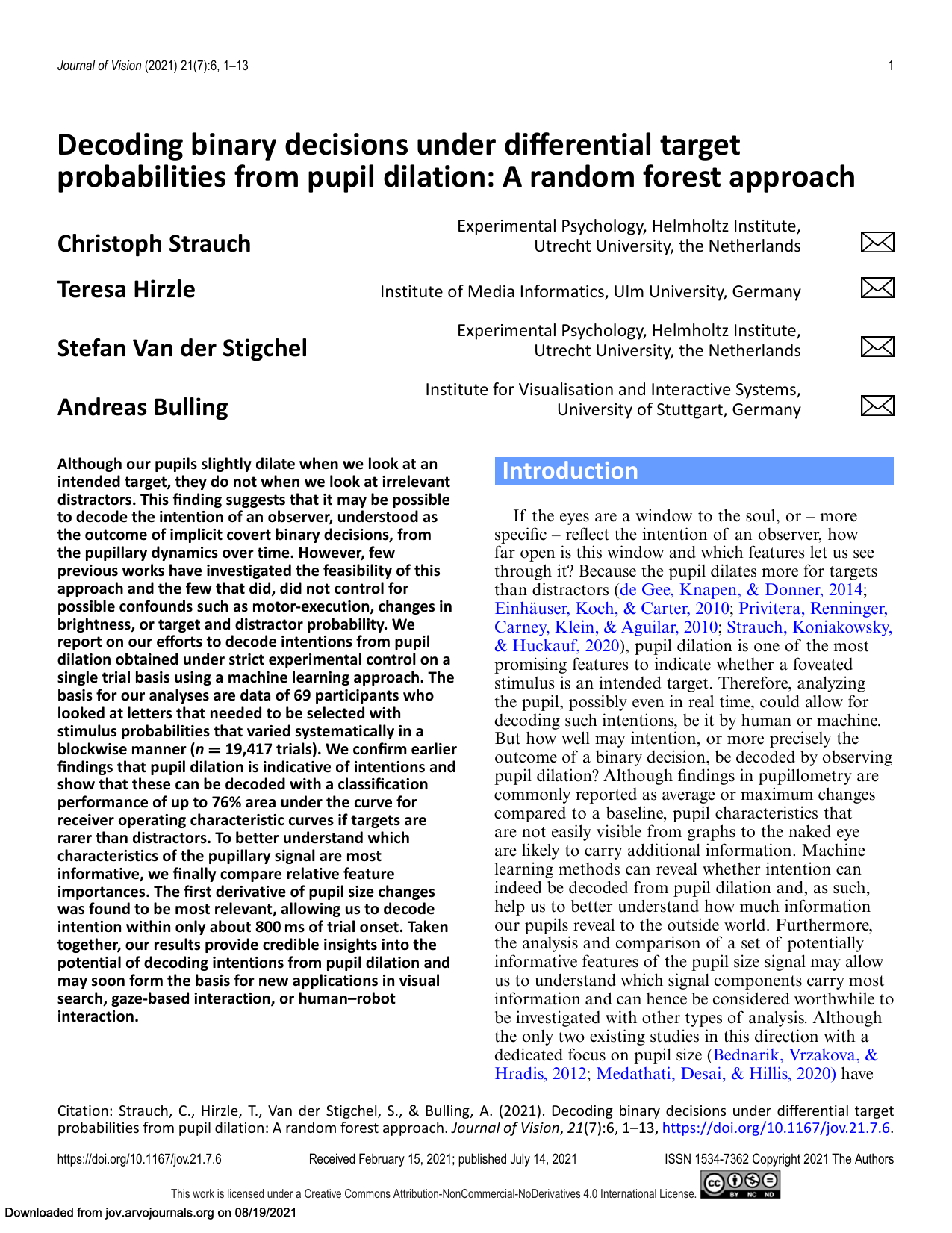
Decoding binary decisions under differential target probabilities from pupil dilation: A random forest approach
Christoph Strauch, Teresa Hirzle, Stefan Van der Stigchel, Andreas Bulling
Journal of Vision (JOV), 21 (7), pp. 1-13, 2021.
AbstractLinksBibTeXProject
While our pupils slightly dilate when we look at an intended target, they do not when we look at irrelevant distractors. This suggests that it may be possible to decode the intention of an observer, understood as the outcome of implicit covert binary decisions, from the pupillary dynamics over time. However, only few previous works have investigated the feasibility of this approach and the few who did, did not control for possible confounds such as motor-execution, changes in brightness, or target and distractor probability. We report on our efforts to decode intentions from pupil dilation obtained under strict experimental control on a single trial basis using a machine learning approach. The basis for our analyses are data of n = 69 participants who looked at letters that needed to be selected with stimulus probabilities that varied systematically in a blockwise manner (n = 19,417 trials). We confirm earlier findings that pupil dilation is indicative of intentions and show that these can be decoded with a classification performance of up to 76% ROCAUC if targets are rarer than distractors. To better understand which characteristics of the pupillary signal are most informative, we finally compare relative feature importances. The first derivative of pupil size changes was found to be most relevant, allowing us to decode intention within only about 800 ms of trial onset. Taken together, our results provide credible insights into the potential of decoding intentions from pupil dilation and may soon form the basis for new applications in visual search, gaze-based interaction, or human-robot interaction.
@article{strauch21_jov,
title = {Decoding binary decisions under differential target probabilities from pupil dilation: A random forest approach},
author = {Christoph Strauch and Teresa Hirzle and Stefan Van der Stigchel and Andreas Bulling},
year = {2021},
journal = {Journal of Vision (JOV)},
volume = {21},
number = {7},
pages = {1-13},
doi = {10.1167/jov.21.7.6},
}
2020
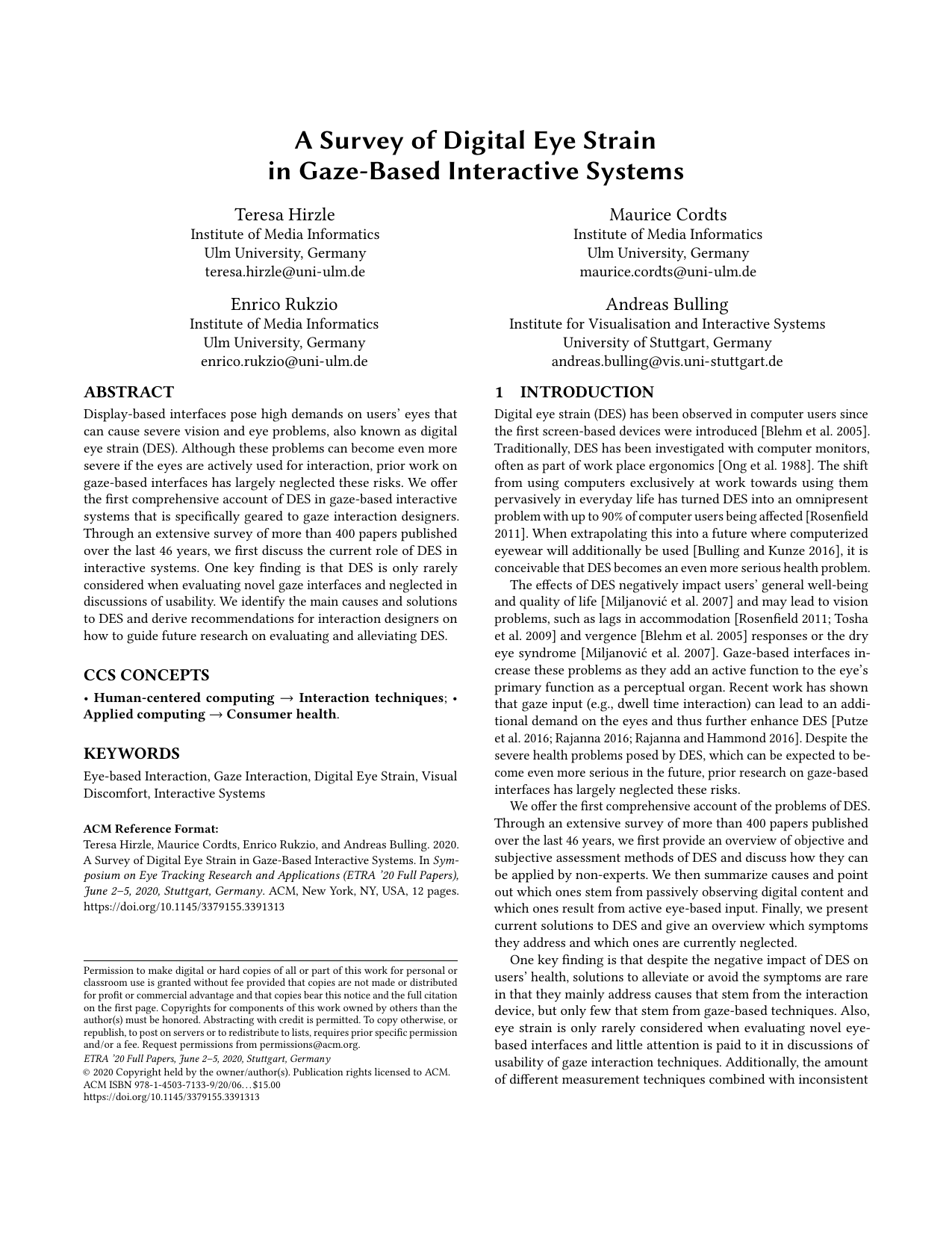
A Survey of Digital Eye Strain in Gaze-Based Interactive Systems
Teresa Hirzle, Maurice Cordts, Enrico Rukzio, Andreas Bulling
Proc. ACM International Symposium on Eye Tracking Research and Applications (ETRA), pp. 1-12, 2020.
AbstractLinksBibTeXProject
Display-based interfaces pose high demands on users’ eyes that can cause severe vision and eye problems, also known as digital eye strain (DES). Although these problems can become even more severe if the eyes are actively used for interaction, prior work on gaze-based interfaces has largely neglected these risks. We offer the first comprehensive account of DES in gaze-based interactive systems that is specifically geared to gaze interaction designers. Through an extensive survey of more than 400 papers published over the last 46 years, we first discuss the current role of DES in interactive systems. One key finding is that DES is only rarely considered when evaluating novel gaze interfaces and neglected in discussions of usability. We identify the main causes and solutions to DES and derive recommendations for interaction designers on how to guide future research on evaluating and alleviating DES.
@inproceedings{hirzle20_etra,
title = {A Survey of Digital Eye Strain in Gaze-Based Interactive Systems},
author = {Teresa Hirzle and Maurice Cordts and Enrico Rukzio and Andreas Bulling},
year = {2020},
booktitle = {Proc. ACM International Symposium on Eye Tracking Research and Applications (ETRA)},
pages = {1-12},
doi = {10.1145/3379155.3391313},
}
2019
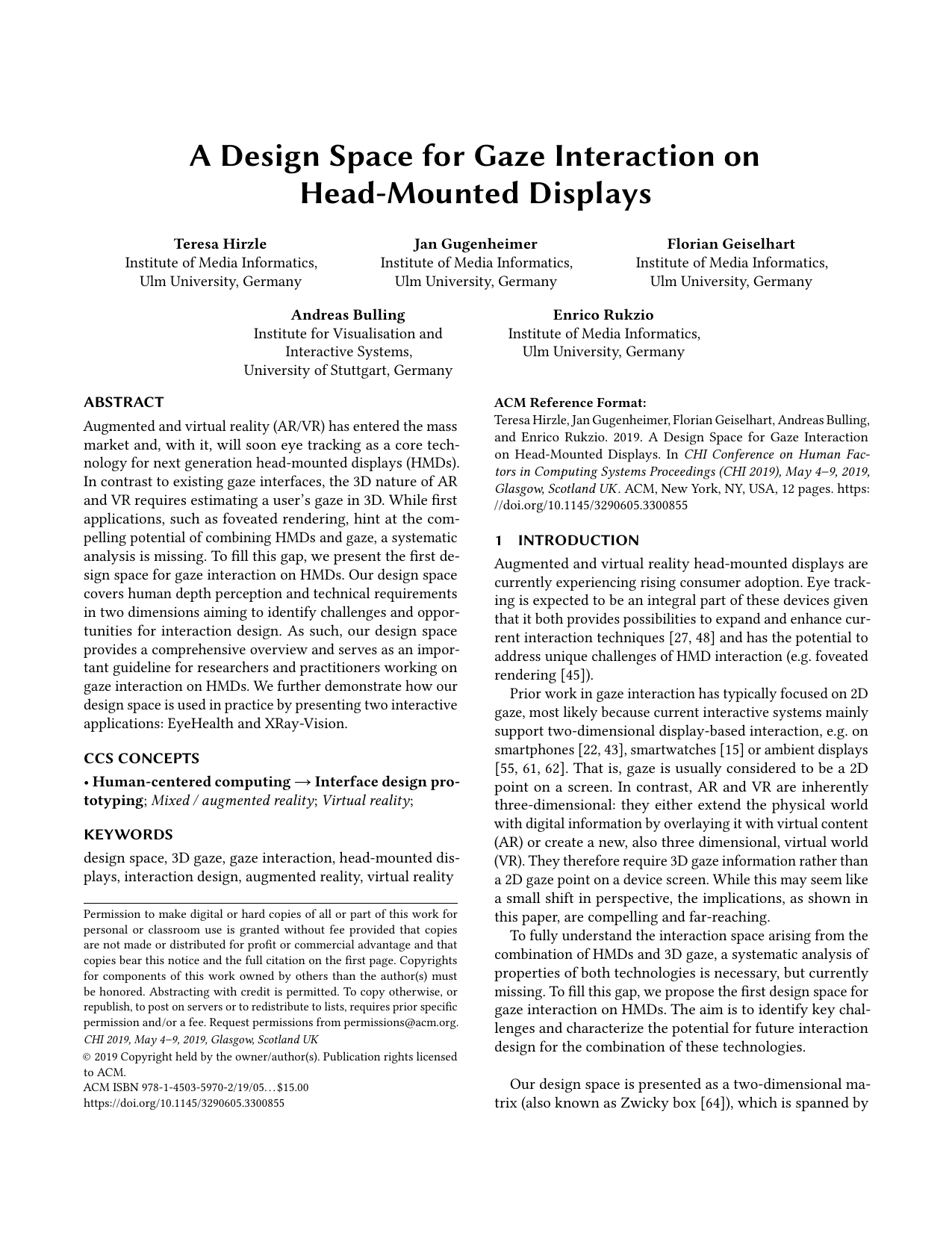
A Design Space for Gaze Interaction on Head-mounted Displays
Teresa Hirzle, Jan Gugenheimer, Florian Geiselhart, Andreas Bulling, Enrico Rukzio
Proc. ACM SIGCHI Conference on Human Factors in Computing Systems (CHI), pp. 1--12, 2019.
AbstractLinksBibTeXProject
Augmented and virtual reality (AR/VR) has entered the mass market and, with it, will soon eye tracking as a core technology for next generation head-mounted displays (HMDs). In contrast to existing gaze interfaces, the 3D nature of AR and VR requires estimating a user’s gaze in 3D. While first applications, such as foveated rendering, hint at the compelling potential of combining HMDs and gaze, a systematic analysis is missing. To fill this gap, we present the first design space for gaze interaction on HMDs. Our design space covers human depth perception and technical requirements in two dimensions aiming to identify challenges and opportunities for interaction design. As such, our design space provides a comprehensive overview and serves as an important guideline for researchers and practitioners working on gaze interaction on HMDs. We further demonstrate how our design space is used in practice by presenting two interactive applications: EyeHealth and XRay-Vision.
@inproceedings{hirzle19_chi,
title = {A Design Space for Gaze Interaction on Head-mounted Displays},
author = {Teresa Hirzle and Jan Gugenheimer and Florian Geiselhart and Andreas Bulling and Enrico Rukzio},
year = {2019},
booktitle = {Proc. ACM SIGCHI Conference on Human Factors in Computing Systems (CHI)},
pages = {1--12},
doi = {10.1145/3290605.3300855},
}
2018
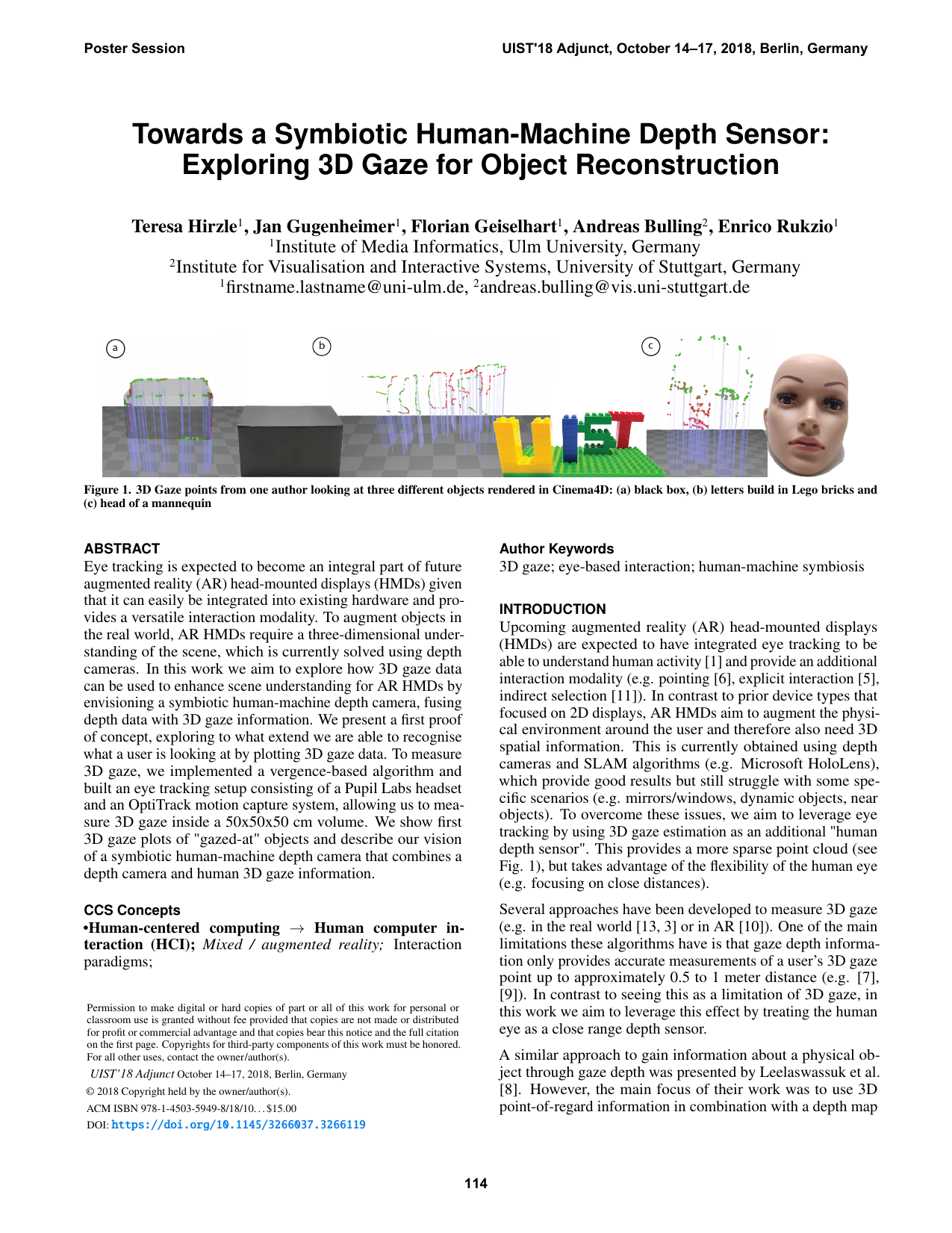
Towards a Symbiotic Human-Machine Depth Sensor: Exploring 3D Gaze for Object Reconstruction
Teresa Hirzle, Jan Gugenheimer, Florian Geiselhart, Andreas Bulling, Enrico Rukzio
Adj. Proc. ACM Symposium on User Interface Software and Technology (UIST), pp. 114-116, 2018.
AbstractLinksBibTeXProject
Eye tracking is expected to become an integral part of future augmented reality (AR) head-mounted displays (HMDs) given that it can easily be integrated into existing hardware and provides a versatile interaction modality. To augment objects in the real world, AR HMDs require a three-dimensional understanding of the scene, which is currently solved using depth cameras. In this work we aim to explore how 3D gaze data can be used to enhance scene understanding for AR HMDs by envisioning a symbiotic human-machine depth camera, fusing depth data with 3D gaze information. We present a first proof of concept, exploring to what extend we are able to recognise what a user is looking at by plotting 3D gaze data. To measure 3D gaze, we implemented a vergence-based algorithm and built an eye tracking setup consisting of a Pupil Labs headset and an OptiTrack motion capture system, allowing us to measure 3D gaze inside a 50x50x50 cm volume. We show first 3D gaze plots of "gazed-at" objects and describe our vision of a symbiotic human-machine depth camera that combines a depth camera and human 3D gaze information.
@inproceedings{hirzle18_uist,
title = {Towards a Symbiotic Human-Machine Depth Sensor: Exploring 3D Gaze for Object Reconstruction},
author = {Teresa Hirzle and Jan Gugenheimer and Florian Geiselhart and Andreas Bulling and Enrico Rukzio},
year = {2018},
booktitle = {Adj. Proc. ACM Symposium on User Interface Software and Technology (UIST)},
pages = {114-116},
doi = {10.1145/3266037.3266119},
}